

Digital PR is the practice of earning coverage in online publications, industry sites and influential blogs to build brand visibility, backlinks and the citations that increasingly shape AI-generated answers. The single most useful thing you can do this week is set one SMART goal (a specific number of referring domains or a ranking position) tied to one target landing page. Campaigns have been built around exactly this discipline for UK SMEs with limited PR budgets.
TL;DR:
- Focus your campaign on one target page and set a clear KPI, such as increasing referring domains by a specific percentage within six months.
- Prioritize building relationships with niche trade outlets and relevant journalists rather than large, broad-audience sites to maximize link quality.
- Use research, reactive comment, or collaborations based on your timeline, with research campaigns better suited for longer planning periods.
- Measure success by tracking backlinks, rankings, referral traffic, and AI citations, anchoring these metrics to a baseline established before outreach begins.
- Allocate your budget primarily to asset creation and measurement tools to ensure your outreach results translate into tangible SEO and AI visibility gains.
Table of Contents
- Your digital PR campaign checklist before you brief anyone
- How do you build a digital PR strategy step by step?
- Which digital PR tactics actually earn links and coverage?
- What KPIs actually prove your digital PR strategy is working?
- How does digital PR support SEO and AI visibility?
- What does a well-briefed digital PR campaign look like in practice?
- How much should you budget for digital PR, and where should it go?
- What do most businesses get wrong with digital PR?
- Get managed support for your digital PR strategy
- Sources
Your digital PR campaign checklist before you brief anyone
Before you brief an in-house team or an agency, tighten these four elements. Skip any one of them and your outreach will drift, and your budget will follow it.
- Set a SMART goal and pick the target page. Decide the metric (referring domains, keyword position, referral traffic) and the exact URL the campaign should support.
- Map your audience to real publications. List the outlets, journalists and newsletters your buyers actually read, not the ones with the biggest domain rating.
- Choose your asset and distribution plan. Decide whether you’re pitching original research, a reactive comment, or a partnership, and how it will reach your media list.
- Assign an owner, a timeline and a simple measurement sheet. One person tracks coverage, links and traffic against your target page from day one.
How do you build a digital PR strategy step by step?
Start with an audit, not an idea. Pull your current backlink profile and check whether existing links point to pages that actually matter for search. Most SMEs discover their strongest coverage links to a blog post from 2022 rather than the service page generating enquiries today.
From there, prioritise. Rank your target pages by commercial value and search opportunity, then decide which two or three deserve a dedicated PR push this quarter. Trying to support every page at once spreads outreach too thin to earn anything.
Media mapping comes next. Build a list of journalists and outlets by relevance and link quality, not by follower count alone. A niche trade title that regularly links out will do more for your target page than a broad consumer site that never credits sources.
- Define the campaign format (research report, expert commentary, partnership, data study).
- Build a 12-month editorial calendar with at least one anchor campaign per quarter.
- Decide whether the work sits in-house or with an agency, and write a one-page brief either way.
- Set review points at 30, 90 and 180 days to check pace against goal.
Green Flag Digital’s guidance on aligning campaigns to ranking targets is worth following closely here: a clever campaign that ignores your SEO priorities wastes the outreach effort behind it.
Pro Tip: Write the brief around the target page first, then the story idea second. Agencies pitch better stories when they know exactly which page needs the authority.
Which digital PR tactics actually earn links and coverage?
Different goals call for different formats. Matching the tactic to your timeline and resources matters more than chasing whichever tactic is trending.
- Original research and data studies. Surveys, proprietary data analysis or an interactive tool give journalists something quotable and unique, which is why original research consistently outperforms other asset types for earning coverage. Best for brands with three to six months to plan and a story worth repeating.
- Reactive PR and newsjacking. Responding fast to breaking news or seasonal trends with expert comment. This depends on social listening and media monitoring tools flagging opportunities in real time, so it suits brands with someone watching the news daily.
- Content and creator partnerships. Co-created guides, joint research or influencer collaborations extend reach beyond traditional media. Useful when your target audience trusts creators more than journalists.
- Link reclamation and broken-link outreach. Finding unlinked brand mentions or dead links pointing to competitor content and asking for the link back. Low cost, steady yield, ideal for smaller budgets.
Pick research-led campaigns when you have lead time and a genuine data angle. Choose reactive PR when speed matters more than depth. Reserve link reclamation for ongoing maintenance rather than a headline campaign.
What KPIs actually prove your digital PR strategy is working?
Measure digital PR the way you’d measure any investment: against a baseline, over a realistic timeline, with more than one metric.
- Referring domains gained against your target page
- Organic traffic and ranking movement on that specific page
- Referral sessions and their conversion rate
- AI citation rate: how often your brand or content appears in AI-generated answers
- Sentiment of coverage and resulting sales enquiries
Set your baseline before the first pitch goes out, because backlink and ranking gains from digital PR typically build over weeks to months rather than days. Track it with your existing analytics platform, a backlink tool, and a simple spreadsheet dashboard that pairs coverage against traffic on the target page.
Modern PR measurement increasingly blends traditional coverage metrics with search and AI visibility metrics, combining link acquisition, search impact and AI citation rate with straightforward business outcomes, according to Shadow’s digital PR strategy guide.
Report monthly, but judge success at the quarter mark. Attribution is never perfectly clean; a spike in branded search two weeks after coverage is a fair signal even without a directly trackable click.
How does digital PR support SEO and AI visibility?
Every campaign should be built around a keyword-target page, not around a story for its own sake. When a journalist links to a page that’s already been optimised for a specific term, that page gets both an authority signal and a relevance signal at once.
Editorial links carry more weight than directory or forum links because they sit inside genuinely useful content, and that same quality is what AI systems draw on when generating answers. Practitioners increasingly report that earned editorial coverage shapes what AI tools cite and recommend, which means a strong placement today can influence how your brand appears in conversational search tomorrow.
To make assets AI-friendly:
- Provide clear sourcing and a short explainer paragraph an editor can quote directly.
- Include embeddable charts and data tables journalists can lift without rewriting.
- Use structured data on the hosting page so search engines and AI crawlers parse it correctly.
- Brief journalists to link to the specific page, not just the domain, to preserve link value.
Online PR itself has widened to cover exactly this: representation inside large language model search systems is now part of the job, not a side effect of it.
What does a well-briefed digital PR campaign look like in practice?
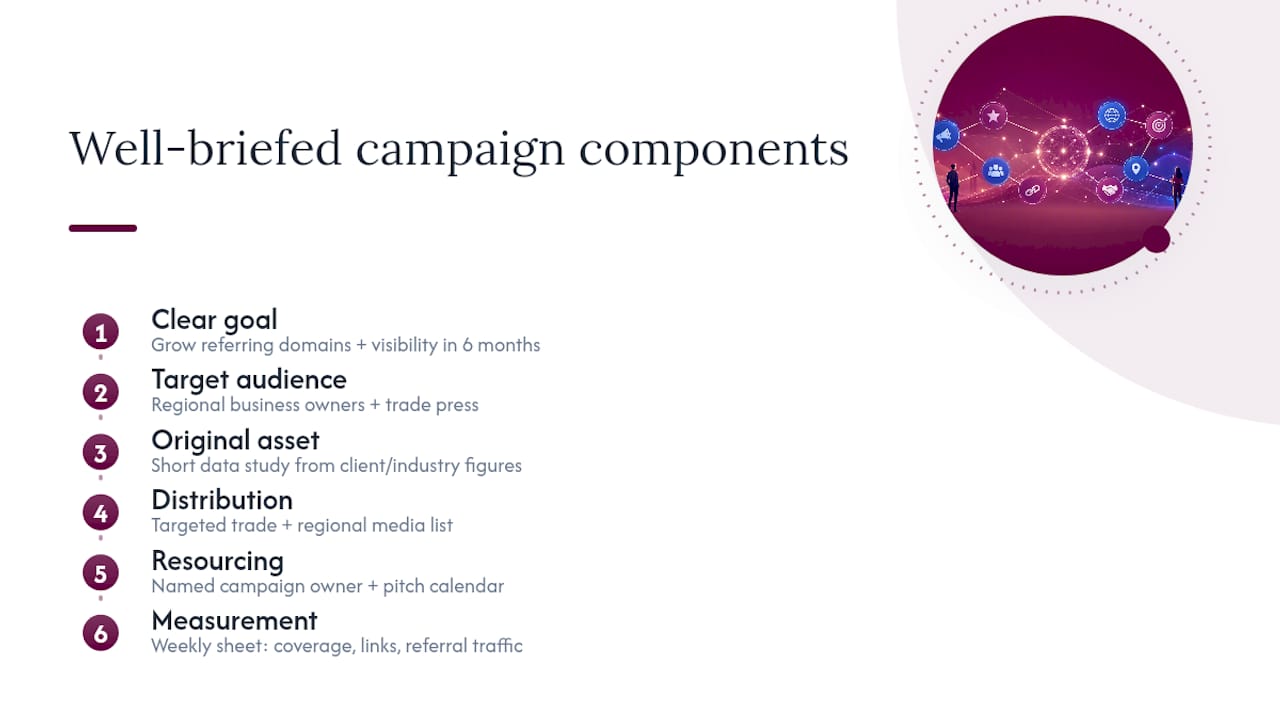
A typical brief for an SME client starts with one goal: grow referring domains and organic visibility to a specific service page within six months. The audience is regional business owners and trade press; the asset is a short data study built from client or industry figures; distribution runs through a targeted media list of trade titles and relevant regional outlets.
This is resourced with a named campaign owner, a pitch calendar, and a measurement sheet tracking coverage, links and referral traffic weekly. Expected outcomes typically appear in phases: initial coverage within weeks, measurable backlink and ranking movement within a few months, and AI citation gains building from there as coverage accumulates.
A backlink gap analysis against competitors, paired with one strong original research asset, tends to produce a stronger first-year yield than scattershot pitching across dozens of small stories.
Antios’ public relations and media relations teams apply this same structure across client sectors, adjusting the asset type to what the audience and journalists actually respond to.
How much should you budget for digital PR, and where should it go?
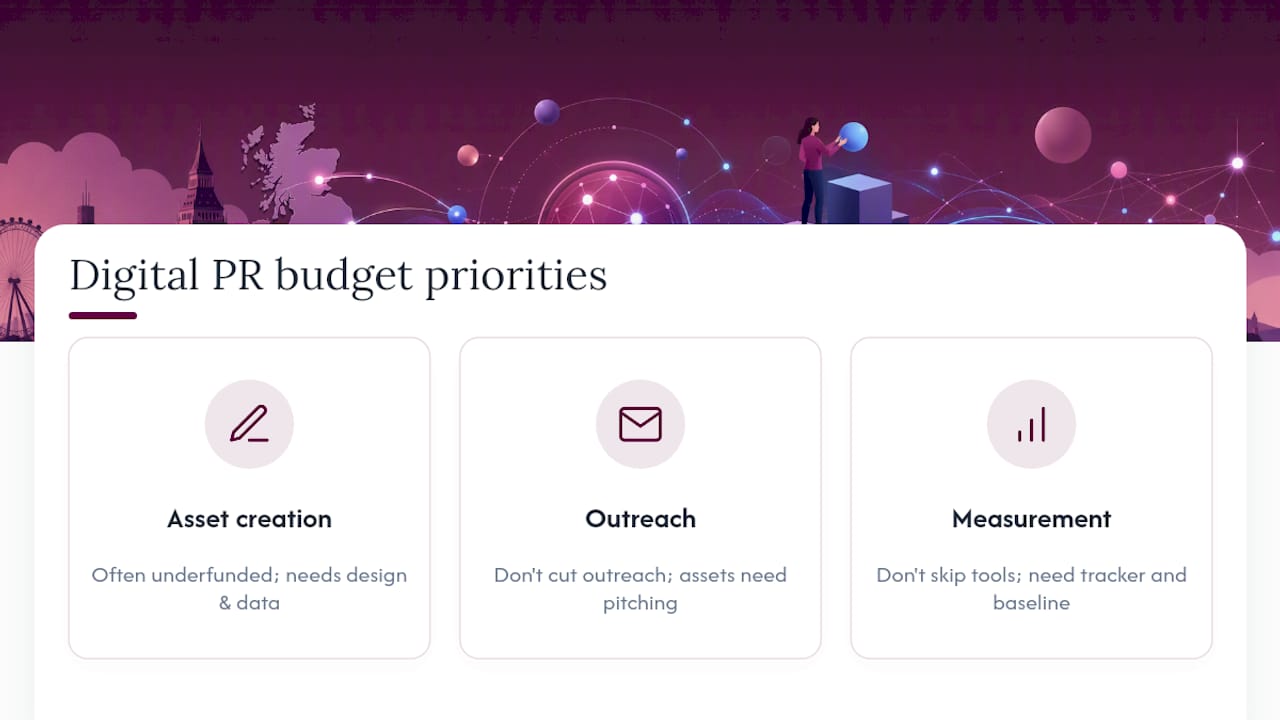
Budget for digital PR splits roughly three ways: asset creation, outreach and distribution, and measurement or tooling. SMEs consistently underfund the first category, briefing an ambitious research campaign and then having nothing left to pay for the design work or data collection that makes it pitchable.
Retainer-based agency support tends to suit brands running continuous campaigns, while project-based fees fit a single research push tied to a launch or seasonal moment. If you’re weighing those models, the SME guide to monthly PR retainers sets out what each structure actually buys you.
Resist the temptation to cut the outreach budget to fund a flashier asset. A brilliant research report with no pitching behind it earns nothing. Equally, don’t skip measurement tools to stretch the creative spend further; without a backlink tracker and clear baseline, you won’t know whether the campaign worked until it’s too late to adjust it. Smaller, well-pitched campaigns run consistently tend to outperform one oversized annual push that exhausts the budget in a single quarter.
What do most businesses get wrong with digital PR?
The first mistake is chasing a clever story with no connection to a target page. It might earn a link, but to the wrong URL, doing nothing for the ranking you actually need. The second is briefing an agency on tactics (“we want three pieces of coverage a month”) instead of outcomes (“grow referring domains to this page by 20%”). Vague briefs produce vague results.
The third is abandoning measurement after the first report. Digital PR compounds; a campaign that looks flat at week six can be building the domain authority that lifts rankings by month four.
My rule of thumb: never brief a campaign without naming the target page first, and never sign an agency contract without a stated KPI in the first paragraph. If you’re choosing between in-house and agency support, weigh it against how much time your team can genuinely give to media relationships, not just content production, since that’s what content agency briefs often miss. The pragmatic next step is simple: pick one page, one goal, and one quarter to test the approach properly before scaling it.
— Anthony
Get managed support for your digital PR strategy
If building media lists, chasing journalists and tracking backlinks isn’t where your team’s time is best spent, this can be run as a managed service built specifically for SMEs working with realistic budgets, not enterprise PR retainers stretched thin across multiple clients.
An initial discovery call covers your target pages, current backlink profile and realistic goals for the next two quarters, then a brief is built around a specific asset and media list rather than a generic press release blast. The team’s public relations service handles campaign planning and journalist outreach end to end, while digital marketing support keeps the SEO alignment tight from brief to publication. Get in touch to scope a campaign around one target page and see what a properly briefed digital PR programme can move in your first quarter.
Sources
For ongoing reference: Mailchimp’s digital PR guide, Shadow’s strategy framework, and a solid backlink monitoring tool alongside your existing analytics platform.