

The fastest way to get media coverage is to develop a genuinely newsworthy story and email one tightly targeted reporter with a brief, usable pitch. Journalists reject most pitches because they lack relevance to their audience, not because the story is weak. Specialist public relations agencies help SMEs sharpen that story and place it correctly when time or contacts run short.
TL;DR:
- Developing a truly newsworthy story with a clear angle, relevant data, and a targeted journalist significantly improves the chances of media coverage.
- A effective media list requires detailed research into reporter beats and recent work, rather than broad or generic outreach.
- A concise pitch under 200 words must include a compelling headline, a core news point, supporting facts, and a specific call to action.
- Building ongoing relationships through regular, newsworthy updates and quick responses increases long-term media presence.
- Outsourcing media relations to specialized agencies is advisable for founders with limited time or resources to sustain effective outreach efforts.
Table of Contents
- How to develop a story journalists will actually use
- How do you build a media list that actually works?
- What should a pitch email actually say?
- How do you prepare for a media interview?
- How do you turn one hit into steady press coverage?
- What actually works for SMEs pitching the media?
- How Antios can help you build a steady media presence
- Sources
How to develop a story journalists will actually use
Journalists ask one question before anything else: so what, for whom, why now? A pitch that cannot answer all three in a single sentence gets deleted within seconds. Your product launch matters to you; it only matters to a reporter if it changes something for their readers, right now, in a way that fits their beat.
Three angle types consistently outperform generic announcements:
- Original data. A survey of your own customers, a pricing analysis, or a trend spotted in your own sales figures gives a journalist something exclusive to report.
- A contrarian founder take. Disagreeing publicly with an industry consensus, backed by evidence, is more reportable than agreeing with it.
- A milestone reframed for audience consequence. “We hired our 50th employee” is not news. “Local hiring in this sector has grown 30% while national figures fell” is.
Turning a routine update into a story is mostly a reframing exercise. A new product feature becomes a story about a shift in customer behaviour. A funding round becomes a story about which problem in the market just got easier to solve. The company fact stays the same; the framing changes who cares.
Whatever the angle, journalists need the same four things to move fast: a one-sentence hook, two supporting facts that hold up under scrutiny, a usable image or data table, and a named contact who replies quickly. Search Engine Land’s reporting on pitch usability confirms that most rejected pitches fail on relevance, not quality of writing. Skipping any of these four elements forces the journalist to do work you should have done for them, and most won’t.
Pro Tip: Write your one-sentence hook before you write anything else. If you can’t compress the story into one sentence a stranger would understand, the story isn’t ready to pitch yet.
How do you build a media list that actually works?
A media list of five carefully researched reporters beats a spreadsheet of two hundred generic addresses. Quality outreach starts with narrowing your beats: identify the two or three subject areas your story genuinely fits, then find the outlets that cover them consistently, not just occasionally.
- Pick your beats first, outlets second. A fintech story needs a finance or startups beat, not a general business desk.
- Read three recent pieces by each target reporter. Note the angle they favour, the length they write to, and whether they use data, case studies, or interviews as their primary evidence.
- Find direct contact details through byline pages, LinkedIn, and X/Twitter bios, where many reporters list an email address or invite direct messages for tips.
- Record four fields per contact: beat, three recent story links, preferred format, and a one-line relevance note explaining why your story fits their pattern.
Founders who pitch this way, directly and with specific homework on the reporter, routinely land coverage without paying an agency, according to Forbes’s reporting on founder-led PR. The research replaces the mass email. It takes longer per contact and produces far fewer wasted pitches.
What should a pitch email actually say?
A pitch has five parts and none of them can be vague: a subject line that states the news, a first sentence that is the news itself, one supporting fact, a link to your assets, and a clear, specific ask.
The first sentence delivers the news, not the backstory. The second sentence gives one hard fact that proves it matters. The email closes with a link to a one-page asset and a direct question, such as whether the reporter wants the full dataset or a fifteen-minute call this week.
- Keep the whole pitch under 150 to 200 words; anything longer reads as a press release, not a conversation.
- Never bury the news in the third paragraph. Reporters scan the first two lines and decide.
- Attach or link assets, never paste large data tables into the email body.
Press releases and newswires still have a place, but a narrower one than most founders assume. They work well for regulatory disclosures, funding announcements that need a timestamped public record, or distributing the same fact to many outlets simultaneously. They rarely work as a substitute for a direct pitch to a specific reporter, because wire copy reads as generic by design. WakeTech’s small business guidance still recommends press releases as one practical tool, among several, not the whole strategy.
Follow-up has rules too. Wait three to five working days before a first follow-up. Send no more than two follow-ups total, each shorter than the original pitch. The second follow-up should offer something new, a fresh angle, an updated figure, an exclusive window, rather than repeating the same ask.
Pro Tip: If a reporter hasn’t replied after two follow-ups, move on. A third email rarely converts and can quietly damage the relationship for your next pitch.
How do you prepare for a media interview?
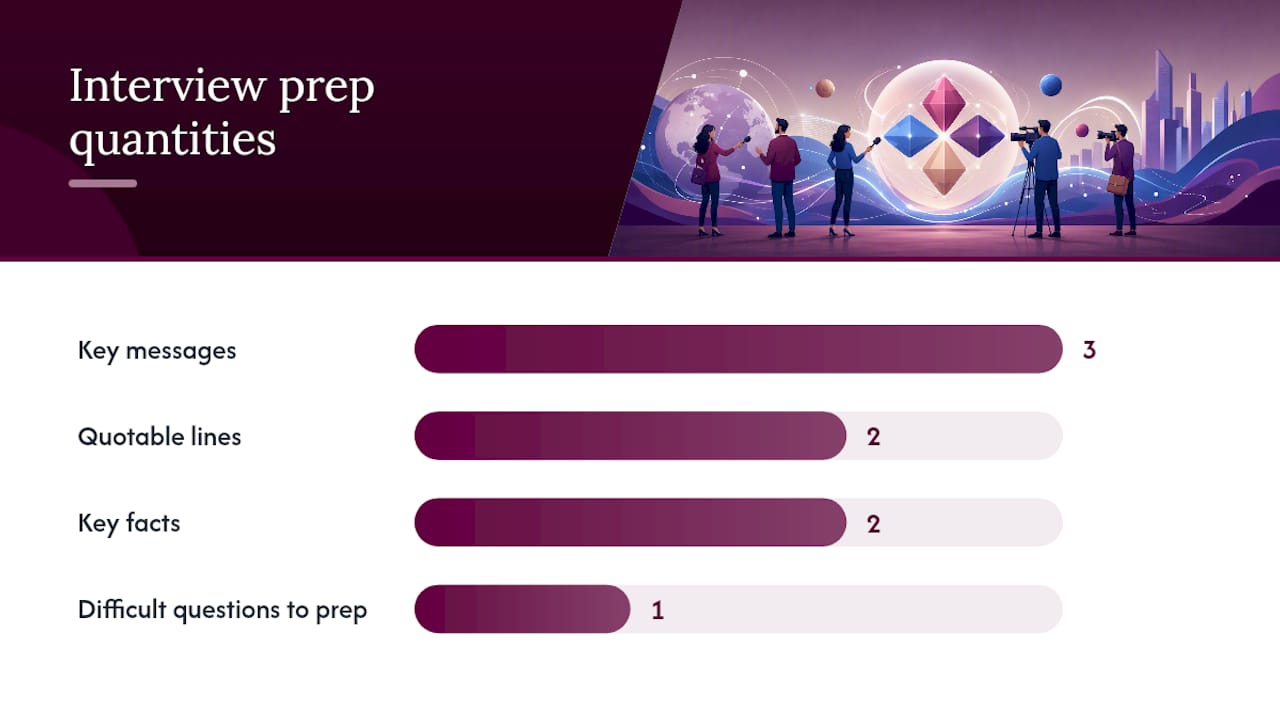
Good interview preparation starts days before the call, not minutes. Build three key messages you want to land regardless of the questions asked, and two quotable lines short enough to survive editing intact. Reporters and producers cut long, hedged answers; a tight, specific sentence survives the edit.
Logistics matter more than most founders expect. Confirm the format (phone, video, in-person), test your microphone and lighting beforehand, and clarify how long the interview will run and whether it’s live or recorded.
- Have your two key facts and one quotable line written on paper in front of you.
- Confirm timing, format, and whether the piece runs live.
- Prepare for at least one difficult or off-topic question in advance.
When a question drifts off-topic or turns hostile, bridge back to one of your three key messages rather than following the reporter’s frame. Repetition of the same clear message, phrased slightly differently each time, is what survives into the final piece.
Journalists increasingly source expert commentary from social platforms and pitch services, where speed and usability count as much as the quality of the data itself, according to Forbes. After the interview, send any promised assets immediately, check that captions and job titles are correct, and flag factual errors politely and quickly rather than waiting for publication.
How do you turn one hit into steady press coverage?
One article is a data point. A relationship is what produces the next five. The founders who keep appearing in coverage treat each journalist contact as ongoing, sending a useful data point or a heads-up on a relevant trend even when they have nothing to pitch that week.
Y Combinator’s guidance for startups recommends keeping a queue of three to five pitchable items running at all times, rather than saving everything for one big launch. A monthly or bi-monthly rhythm of smaller, genuinely newsworthy items keeps your name in a reporter’s inbox without becoming noise.
- Reply to journalist requests within hours, not days; speed often decides who gets quoted.
- Send a useful fact or dataset occasionally with no ask attached.
- Offer a well-chosen reporter an exclusive rather than blasting the same story to twenty outlets.
Measuring impact doesn’t require an elaborate dashboard. Track branded search volume before and after coverage, inbound enquiries that mention where they found you, and any backlinks the piece generates. A rough estimated media value figure can help internally, but treat it as directional, not precise.
Modern PR functions best as an integrated system: earned coverage, owned content, and paid amplification reinforcing each other rather than working in isolation, a point Fein PR’s 2026 guidance makes plainly. Once outreach, follow-up, interview prep, and list building start eating a founder’s week every week, that’s usually the signal to bring in an agency to handle media relations rather than absorb the time cost indefinitely.

What actually works for SMEs pitching the media?
Most SMEs overestimate how much their news matters to a stranger and underestimate how much research a good pitch requires. The businesses that get coverage repeatedly aren’t the ones with the biggest news. They’re the ones who’ve done the reporter’s homework before hitting send.
The most common mistake isn’t a bad pitch, it’s no follow-up plan and no next story queued up behind the first one. Coverage that looks like luck from the outside is almost always a founder who pitched five reporters, heard back from one, and already had the next angle ready. The second most common mistake is paying for contributor placements or guest posts dressed up as editorial coverage. Search Engine Land warns this routinely violates outlet guidelines and can get content deleted and the source blacklisted.
If there’s one lesson from client work, it’s that the businesses who treat press as a monthly habit, not a one-off event, are the ones journalists start calling first.
— Anthony
How Antios can help you build a steady media presence
Not every founder has the hours to research beats, draft pitches, and chase follow-ups on top of running the business, and agencies like Antiosmulticoncepts fill this gap for UK SMEs.
Antios runs media relations campaigns that handle journalist research, pitch drafting, and follow-up cadence on a client’s behalf, alongside broader public relations work covering content, digital amplification, and reputation management. Crisis situations get separate attention through dedicated crisis management support, since a difficult interview handled badly can undo months of earned coverage in a single news cycle.
Engagements can run either project by project, useful for a single launch or announcement, or on a retainer basis for businesses that want a continuous queue of pitchable stories and ongoing journalist relationships. Which model fits depends on whether you need one result or a sustained media presence. If chasing reporters isn’t where your time is best spent, consider contacting a public relations agency to discuss a media relations plan built around your business.