

Use an embargo only when extra lead time will genuinely improve the coverage: complex research, major product launches, or news that needs journalists to prepare properly before publication. The one rule that decides whether it holds is explicit journalist consent paired with a precise lift time, stated as an exact date, time, and time zone.
TL;DR:
- Embargoes are best reserved for complex, time-sensitive stories like research releases, major product launches, or market-moving financial announcements.
- Proper adherence relies on explicit journalist consent, precise timing with time zones, and careful management of the distribution list to prevent early publication.
- Failures often stem from vague agreements, timing ambiguity, over-distribution, or repetitive, low-value embargoes that erode credibility.
- Clear, staged processes—including staged assets, version control, and advance consent—are essential for embargo integrity and swift response to breaches.
- Smaller, targeted lists and rapid breach management are more effective than broad outreach or vague policies, with success measured by timing accuracy, coverage depth, and message fidelity.
Table of Contents
- What is an embargo press release, and when should you use one?
- Why do embargoes fail, and when should you avoid one?
- How do you write and package an embargoed press release?
- How do you secure journalist consent and manage the distribution list?
- What happens if an embargo breaks, and how do you manage the window?
- How do you measure whether an embargo worked?
- What are PLOS and Nature’s embargo policies, and why do they matter?
- Copy-ready templates for your next embargoed release
- Lessons from watching embargoes hold and fall apart
- How Antiosmulticoncepts supports embargoed launches and crisis readiness
- Sources
What is an embargo press release, and when should you use one?
An embargo press release gives journalists advance access to news on the condition that nothing publishes before a specified date and time. It differs from an exclusive, which grants one outlet sole rights to a story, and from a standard pitch, which carries no timing restriction at all. A news embargo works on trust rather than legal enforcement, a “gentlemen’s agreement” that has underpinned business, government, and academic reporting for decades.
That informality is precisely why discipline matters. You are not relying on a contract lawyers could enforce. You are relying on the reputation of your organisation and the professional norms of the journalists you work with.
Embargoes earn their place when the story is genuinely complex or time-sensitive enough that extra preparation time changes the quality of the coverage. That covers a narrower set of situations than most PR calendars suggest:
- Research and data releases where journalists need time to read a full report, check methodology, and possibly seek independent comment.
- Major product or company launches involving multiple moving parts, spokespeople, and media formats that take longer than a same-day turnaround allows.
- Regulated or market-moving announcements, such as financial results or clinical findings, where simultaneous release protects fairness and compliance.
- Multi-outlet coordinated stories, where you want broad, consistent coverage on a single day rather than a trickle of pieces over a week.
Run a simple test before committing to an embargo: will the extra lead time materially change what journalists produce, or are you just adding process for the sake of feeling organised? If a story is straightforward enough that any competent reporter could write it from your release in twenty minutes, an embargo adds friction without adding value. Save the mechanism for news that rewards the time you’re giving away.
Why do embargoes fail, and when should you avoid one?
Most embargo failures trace back to the same handful of mistakes, and none of them are exotic. The Contentgrip framework for PR teams treats a workable embargo as a contract with four explicit terms: what is covered, who else has it, exactly when it lifts, and what happens if someone breaks it. Skip any one of those terms and you have built a trap for yourself.
False agreement is the most common failure. A journalist opens your email, skims it, and starts drafting, assuming the embargo line was just formatting rather than a binding request they actually accepted. If you never got an explicit “yes, I agree” back, you don’t have consent. You have a hope.
Timing ambiguity comes a close second. “Monday morning” means nothing across time zones and different newsroom shift patterns. Without a stated time zone and exact hour, someone will publish early in good faith.
Over-distribution dilutes accountability. The more people who receive an embargoed release, the harder it becomes to identify who broke it, and the more likely someone treats the restriction as optional because “everyone else has it too.”
Weak news under embargo breeds cynicism. If journalists repeatedly find that your “embargoed” announcements are routine and forgettable, they stop taking your embargo requests seriously, and that scepticism spreads across the beat.
The relationship cost outweighs any single missed placement. An editor who feels manipulated by a fake embargo, or burned by one that collapsed through your own poor process, remembers that far longer than they remember the story itself.
- Never mark routine news as embargoed simply to create a sense of occasion.
- Never send full details before securing individual consent from each contact.
- Never assume silence means agreement.
Pro Tip: If you can’t articulate, in one sentence, why the story needs the embargo, don’t use one. “Because it feels more important that way” isn’t a reason.
How do you write and package an embargoed press release?
Precision in the document itself is what prevents accidental early publication. Everything here should be built so that a busy journalist skimming quickly still cannot misread the terms.
Follow this sequence when drafting and assembling the package:
- Write the embargo notice first, before the headline. State it plainly: “EMBARGOED UNTIL 09:00 GMT, Tuesday 17 March 2026 — not for publication before this date and time.” Put an abbreviated version in the subject line too, e.g. “EMBARGOED: [Story name] — lifts Tue 17 Mar, 09:00 GMT.”
- Draft the release body in the standard order: headline, lede paragraph answering who/what/when/why, three or four proof points or supporting data, at least one quote from a named spokesperson, a boilerplate paragraph about your organisation, and a media contact with a direct phone number and email.
- Assemble the asset pack separately from the release text: underlying data tables, a plain-language methodology note if research is involved, high-resolution images with correct licensing, and a note on spokesperson availability with time zones for interview scheduling.
- Version-control every file. Use a naming convention such as
CompanyName_ReleaseTitle_EMBARGO_170326.pdfso nobody in your own team, or theirs, opens or forwards an outdated draft by mistake. - Send the full package only after consent is logged, not before. This matches the sequencing that PRLab’s embargo guide recommends: consent first, complete materials second.
Formatting choices that seem cosmetic actually reduce accidental publishing risk considerably:
- Put the embargo notice in bold, capitalised, and repeated at both the top and bottom of the document.
- Avoid embedding the embargo time only in an email body that could get separated from an attachment.
- Watermark or label draft images so a picture desk doesn’t accidentally pull one into a live CMS.
- Keep the asset pack in a single shared folder with access logs, rather than scattering files across multiple email threads.
- State the lift time in at least two formats: local time zone and Greenwich Mean Time or Coordinated Universal Time, to remove any translation error for international recipients.
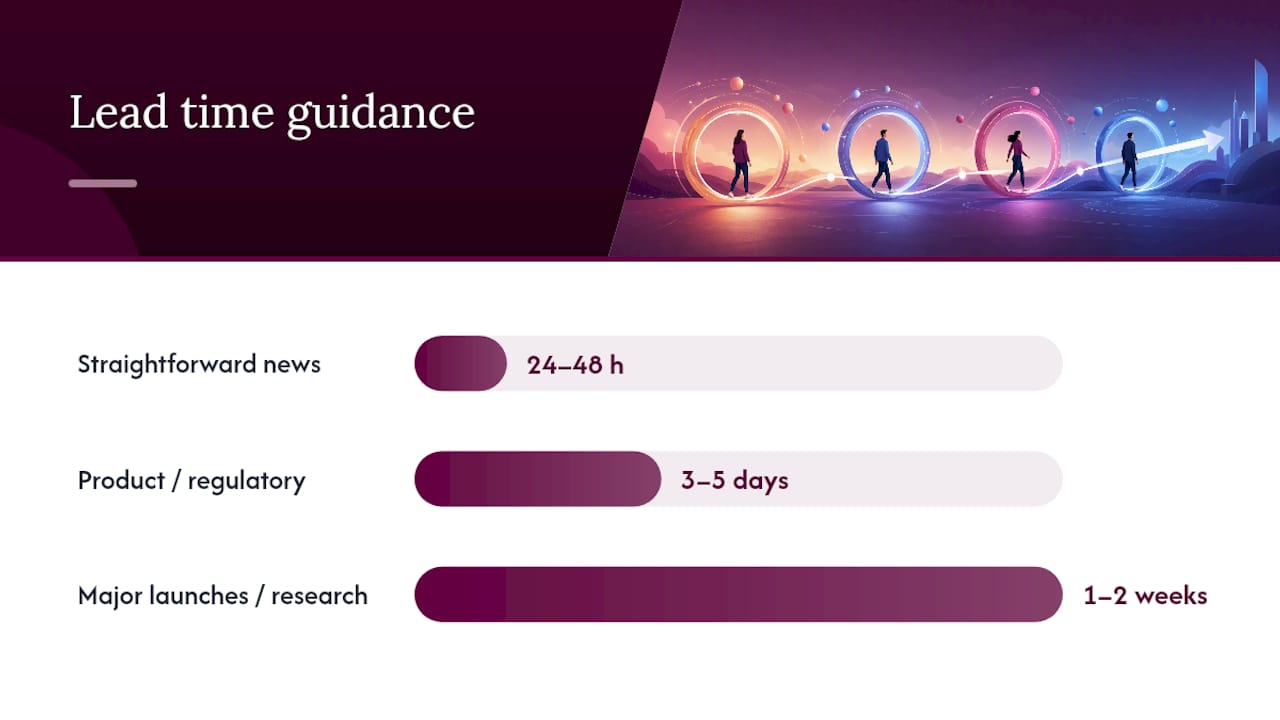
Lead time should match the complexity of the story. Practitioner guidance from PRLab suggests roughly 24 to 48 hours for straightforward news, three to five days for product or regulatory announcements, and up to one or two weeks for major launches or research findings that need independent verification. Anything shorter than several hours rarely gives a reporter enough runway to do more than skim your release, which undercuts the entire purpose of embargoing it in the first place.
How do you secure journalist consent and manage the distribution list?
Consent is not implied by sending an embargoed release. It has to be requested and confirmed before the material goes out, and the confirmation has to be logged somewhere your team can reference later.
Follow this outreach sequence for every embargoed story:
- Send a short consent request first, separate from the release itself. State the topic in one line, the proposed lift date and time, and ask directly: “Are you happy to receive this under embargo on those terms?”
- Wait for an explicit reply before sending the full package. A read receipt or an opened email is not consent; a typed “yes” or a reply confirming the terms is.
- Log the exact lift time each contact agreed to, including their stated time zone, in a shared tracking sheet accessible to your whole comms team, not just the person who sent the email.
- Send the complete asset pack once consent is confirmed, referencing the agreed terms again in that follow-up so there is no ambiguity about what was promised.
- Track receipt and read status so you know, in real time, exactly who holds the story and when they opened it.
Building the right list matters more than building a large one:
- Keep the list curated to reporters who actually cover the relevant beat, rather than blasting a general media database.
- Favour outlets and individual journalists with a track record of respecting embargo terms overreach alone.
- Resist the temptation to add “just in case” recipients; every extra name is another point of failure.
- Send a single, polite reminder roughly 24 hours before the lift time, restating the exact time and time zone.
Antiosmulticoncepts’s media relations work for SME clients consistently shows that a tightly curated list of ten genuinely relevant journalists outperforms a scattergun list of a hundred. Fewer relationships, managed properly, produce more accurate and better-placed coverage than volume ever does.
What happens if an embargo breaks, and how do you manage the window?
Monitor actively for the full duration of the embargo window rather than assuming silence means compliance. Set up media monitoring alerts for your key terms, check newsroom feeds and social channels for the outlets holding the story, and watch for early social media chatter from spokespeople or partners who might inadvertently tip off the announcement themselves.
Early warning signs are usually small: a journalist asking unusually specific follow-up questions ahead of schedule, a competitor outlet suddenly requesting the same story, or a spokesperson mentioning details on a personal social account without realising the sensitivity.
If someone publishes early, speed matters more than perfection. Work through this sequence:
- Confirm the breach is real before reacting, rather than assuming the worst from a partial headline or a misleading social post.
- Contact every other journalist holding the embargo immediately, informing them the embargo has broken and giving them the choice to publish now.
- Decide, with your team lead’s sign-off, whether to lift the embargo entirely for everyone rather than leaving some outlets waiting while others have already gone live.
- Publish your own owned-channel materials the moment you decide to lift, so your version of the story is live and accurate rather than being defined entirely by whoever broke the embargo.
Having your assets already staged and ready to publish the instant a decision is made costs almost nothing to prepare and meaningfully limits the damage when things go wrong.
Decide in advance who has authority to make that lift call. A vague “we’ll figure it out” chain of command wastes the first, most valuable hour after a breach. Name one person, usually the most senior communications lead on the account, who can approve moving the public release time without waiting for a committee.
A short holding script helps enormously in the moment: “Apologies, but [Outlet] has published ahead of the agreed embargo time. We’re lifting the embargo for all recipients as of now. Please feel free to publish. Full assets are attached.” Having that wording ready before you need it saves precious minutes.
Pro Tip: Draft your breach-response email templates before you ever send an embargo, not after one breaks. Nobody writes calmly under pressure.
How do you measure whether an embargo worked?
Judge an embargo’s success against concrete indicators, not just gut feel about how the launch day went.
Track these KPIs after every embargoed announcement:
- Timing accuracy: what proportion of outlets published exactly at, or after, the agreed lift time?
- Publication accuracy: how closely did coverage match your facts, figures, and framing, versus how many outlets introduced errors?
- Message pull-through: did your key phrases, statistics, or positioning actually appear in the resulting coverage?
- Depth of coverage: did journalists produce substantive pieces reflecting the extra preparation time, or shallow rewrites that suggest the embargo added nothing?
- Outlet relevance: did the coverage land with audiences that actually matter for your goals, rather than volume for its own sake?
Collecting this is straightforward with the right process. Run media monitoring across the lift window to capture timing data automatically, conduct a manual content audit comparing published pieces against your original release for accuracy, and sample a handful of the more important pieces for editorial depth and tone.
Feed the results back into your next decision. If most outlets treated a “24 hour” embargo as a formality and published near-identical rewrites, that’s a signal the lead time didn’t add real value, and a shorter, simpler pitch might have worked just as well next time.
What are PLOS and Nature’s embargo policies, and why do they matter?
Academic and research announcements sit under stricter rules than most commercial PR, and getting them wrong can burn a journalist’s professional standing, not just yours.
PLOS’s embargo policy gives registered journalists equal access to embargoed research, explicitly forbids exclusives, and removes any journalist who breaks the embargo from future press access. Nature Portfolio’s press and embargo policies work on similar principles: fixed embargo times stated precisely, discouragement of media outreach before a publication date is confirmed, and removal of outlets that break the terms.
Both publishers typically allow registered journalists access up to a week ahead of publication, provided timing, including time zone, is stated with total precision. That access is a privilege tied to registration status, not a default entitlement.
For PR teams working alongside university or institutional press offices on research-related announcements, that means adjusting your usual playbook:
- Confirm with the institutional press office whether the underlying journal enforces a “no exclusives” rule before you promise any single outlet special access.
- Register spokespeople and journalists through the publisher’s own system where one exists, rather than working entirely through informal contacts.
- Treat any preprint carefully. Publicising research ahead of formal publication can violate a journal’s own embargo terms even if your organisation’s release timing looks fine on its own.
- Never promise a journalist exclusive early access to peer-reviewed research; the publisher’s policy overrides your intentions regardless of what you’d like to offer.
Copy-ready templates for your next embargoed release
Use this notice at the very top of the release and in the subject line: “EMBARGOED UNTIL [09:00 GMT, Tuesday 17 March 2026] — Not for publication, broadcast, or online posting before this time.”
A one-page release skeleton, in order:
- Embargo notice (bold, top and bottom)
- Headline and one-sentence subhead
- Lede paragraph: who, what, when, why it matters
- Three to four proof points or data references
- One named spokesperson quote
- Boilerplate paragraph
- Media contact name, email, and direct phone number
Printable checklist before you hit send:
- Consent confirmed and logged for every recipient
- Exact date, time, and time zone stated at least twice in the document
- Asset pack version-controlled and file-named consistently
- Distribution list reviewed for relevance, not just size
- Breach-response templates drafted and approved in advance
Lessons from watching embargoes hold and fall apart
Most embargo failures I’ve seen trace back to overconfidence rather than bad luck. A comms team assumes an email was clear enough, skips the explicit consent step because “everyone always says yes anyway,” and gets caught out the one time a junior reporter didn’t realise the timing was binding.
The worst break I’ve encountered involved a regional trade outlet publishing six hours early simply because nobody had specified a time zone, and the reporter genuinely believed they’d waited long enough. The fix wasn’t complicated: contact every other outlet immediately, lift the embargo for everyone rather than leave some waiting, and publish the owned assets straight away so the story wasn’t defined by someone else’s early version. The relationship survived because the response was fast and honest, not because the mistake never happened.
That’s the real lesson. Discipline in the paperwork prevents most breaks, but recovery speed is what protects the relationship when discipline isn’t enough. If your team needs that kind of operational rigour built in from the start, that’s exactly the gap a specialist agency exists to close.
— Anthony
How Antiosmulticoncepts supports embargoed launches and crisis readiness
An alternative to running embargo logistics on a spreadsheet and hoping nobody misreads the timing exists for UK SMEs without a dedicated press office, offering management of the parts that determine whether an embargo holds: securing and logging journalist consent, staging the release and asset pack ahead of the lift time, and monitoring coverage across the embargo window.

One example of what that looks like in practice: before any embargoed release goes out, consent is confirmed with each named journalist individually, the agreed lift time is recorded against their contact record, and assets kept staged and ready to publish instantly if a leak forces an early lift. That’s the operational discipline that separates an embargo that generates strong, accurate coverage from one that collapses into a scramble.
If you’re planning a launch, a research announcement, or any news that depends on getting the timing right, get in touch through our public relations team and we’ll talk you through how we’d handle it for your announcement.
Sources
- Guidelines for journalists and press officers – PLOS
- Press and embargo policies | Nature Portfolio
- Embargoed press release guide for PR teams — Contentgrip
- News embargo — Wikipedia