

The three levers that actually work are removal at source, Google’s official removal tools if you qualify, and suppression through authoritative content when nothing else applies. Legal action against defamatory material is a fourth, specialist route, but it is slower and costlier than most people expect. Anthony Babafemi Raji MON, Operations Director at Antios Multi-Concepts UK Limited, has built this playbook around one rule: fix the source first, because deindexing alone rarely satisfies an AI system reading the web today.
TL;DR:
- Removing the source at the original URL is the most effective way to prevent future appearances and feeding by AI systems, rather than just deindexing.
- Legal removal options are limited to false factual claims causing harm or copyright infringement, with court cases often taking months and costing thousands.
- Google only deindexes content, which means the source page remains accessible; using tools like Outdated Content requires the source to be genuinely changed or removed.
- Prioritizing the building of authoritative, optimized online profiles over suppression efforts yields better long-term reputation control within a 2 to 6 month timeframe.
- Costs for removal or suppression vary from free online tools and publisher outreach to expensive legal fees, with professional agencies offering speed and expertise at a retainer or project fee.
Table of Contents
- How do you triage a negative article before acting?
- Contacting the publisher: what actually gets results
- What will Google actually remove from search results?
- When does legal action make sense?
- Building suppression: how to outrank a negative article
- How do you track a multi-URL removal project without losing your place?
- How do you confirm the removal actually worked?
- Author and agency proof: why Antios Multi-Concepts can help reduce negative coverage
- How privacy law affects your removal options by jurisdiction
- What does removing negative content actually cost?
- What actually matters most in reputation repair
- How Antios Multi-Concepts can help you manage this
- Sources
How do you triage a negative article before acting?
Not every damaging URL deserves the same response, and treating them all identically wastes time and sometimes makes things worse. Run each one through three questions before you touch a phone or a keyboard.
- Is the page still live, or has it already vanished from the source but lingers in Google’s index? A cached, dead page needs a different tool than a live one.
- Is there a factual error or defamatory claim, or is this accurate but unflattering reporting? Opinion and fair comment rarely qualify for removal on legal grounds.
- Is there a court order, expungement, or sealed record behind the story? If so, that document becomes your strongest evidence for everything that follows.
Search the headline and key phrases in quotation marks to catch syndicated copies and scraper sites republishing the same story. Syndicated copies are frequently what AI models cite, so a clean original with five scraper copies still live solves nothing. Each triage outcome points somewhere specific: live and false leads to publisher contact or legal review; dead-but-indexed leads to Google’s Outdated Content tool; syndicated leads to a copy-by-copy cleanup list.
Contacting the publisher: what actually gets results
Find the right person before you write anything. Larger outlets have a standards editor or a corrections page; smaller sites often hide contact details, so a WHOIS lookup on the domain can surface a registrant email when nothing else works.
A request that gets ignored is usually vague. One that gets acted on includes:
- The exact publication date and URL of the piece.
- Specific evidence showing the factual error, outdated status, or resolved matter.
- A clearly stated remedy: correction, anonymisation, noindex tag, or full removal.
- A professional, time-bound tone with no threats in the first message.
Escalate calmly if you hear nothing within two weeks. A second, firmer email referencing your first request usually outperforms a public complaint. Publicly confronting a journalist or publication rarely helps and often draws more attention to the story, since engaging publicly tends to backfire and private outreach performs better.
Pro Tip: Send removal requests from a named individual with a verifiable role, not a generic company inbox. Editors respond faster to a real person with something specific to say than to a form email.
What will Google actually remove from search results?
Google offers three relevant pathways, and none of them delete the underlying page. They deindex it, which is a different outcome entirely.
- Results About You covers search results showing your personal information, such as a home address, phone number, or ID data appearing without your consent.
- Personal content removal forms handle specific categories including non-consensual imagery and doxxing content.
- The Outdated Content tool requests a fresh crawl once the source page has genuinely changed or been taken down, useful when a publisher has already agreed to edit or remove a story.
Google’s removal tools deindex results but never delete the source page itself, which matters because anyone with the direct link, or any AI crawler that already indexed it, can still reach the content. Submit evidence of the change (a screenshot, the corrected URL, or confirmation from the publisher) and file the Outdated Content request only after the source has actually been edited or removed. Processing typically takes days to a few weeks.
When does legal action make sense?
Legal remedies exist for a narrower set of cases than most people assume. Defamation claims require a false statement of fact, not merely an unflattering one; genuine opinion and accurate negative reporting usually survive a legal challenge intact.
- Defamation applies when the published claim is factually false and has caused measurable harm.
- DMCA takedowns apply when someone has used your copyrighted material, such as photos or written content, without permission.
- Court orders can force permanent removal and deindexing, but they take months and legal fees to secure.
- Right to be Forgotten (delisting) exists for EU and UK residents under GDPR, though it applies to search listings rather than the original publication and carries public-interest exceptions.
Reputation repair timelines vary sharply by route: data-broker and platform removals can clear in days to weeks, suppression work typically runs 2 to 6 months, and legal routes are measured in months. Filing a lawsuit against a small blog over a minor factual point can also trigger the Streisand effect, drawing far more attention to the story than it ever had before you sued.
Building suppression: how to outrank a negative article
When removal genuinely is not an option, the practical answer is to make the negative page the tenth-best result instead of the first. That means building a stronger footprint above and around it.
- Claim and fully optimise every high-authority property tied to your name: an exact-match domain, LinkedIn profile, YouTube channel, and relevant industry directories.
- Publish earned media coverage and contributed articles on outlets Google already trusts, rather than relying only on owned channels.
- Interlink your owned assets so search engines and AI crawlers read a coherent, consistent entity rather than scattered fragments.
Expect meaningful movement within 2 to 6 months rather than weeks, matching the suppression timelines seen across reputation cleanup case work. Success looks like new, positive URLs occupying page-one positions, because source removal now carries more weight than in previous years since AI systems still surface deindexed content that remains technically accessible.
Pro Tip: Prioritise the two or three properties Google already trusts for your name (usually LinkedIn and a personal or company domain) before spreading effort across a dozen minor profiles.
How do you track a multi-URL removal project without losing your place?
A spreadsheet beats memory once you are juggling more than two or three problem URLs. Track, at minimum: the URL itself, its current live/removed status, any syndicated copies found, contact attempts and dates, relevant legal documents, and the triage outcome assigned to it.
- Sequence matters: where an expungement or sealed record exists, secure that document first, since it becomes your strongest evidence for every subsequent request rather than something you retrofit later.
- Prioritise URLs ranking on page one for your name before chasing lower-visibility copies.
- Hand the file to counsel or a specialist agency once a clear legal basis appears, or once syndicated copies exceed what one person can realistically track.
How do you confirm the removal actually worked?
Checking once is not verification. Run the same search fresh, in an incognito window, across Google Search, Google News, and cached results, and repeat weekly for the first month.
- Check the Outdated Content tool’s own status page to confirm your recrawl request processed.
- Query AI surfaces directly, including ChatGPT, Perplexity, and Google AI Overviews, using the same name and phrase searches a curious contact would use.
- Log every URL any AI system cites in its answer against your tracker, since AI search often surfaces syndicated copies even after the original is gone.
- If a copy still appears, repeat outreach to that specific host rather than assuming the original removal covers it.
Remaining citations usually trace back to a scraper site your first sweep missed. Add it to the tracker and start the contact sequence again.
Author and agency proof: why Antios Multi-Concepts can help reduce negative coverage
This playbook is authored by Anthony Babafemi Raji MON, Operations Director at Antios Multi-Concepts UK Limited. [Credentials and case study placeholder: relevant qualifications and prior reputation management outcomes to be inserted.] Antios has published guidance across reputation and profile management, media relations, and crisis response. The approach follows the sequence outlined here: triage first, remove at source where feasible, then suppress with authoritative coverage.
How privacy law affects your removal options by jurisdiction
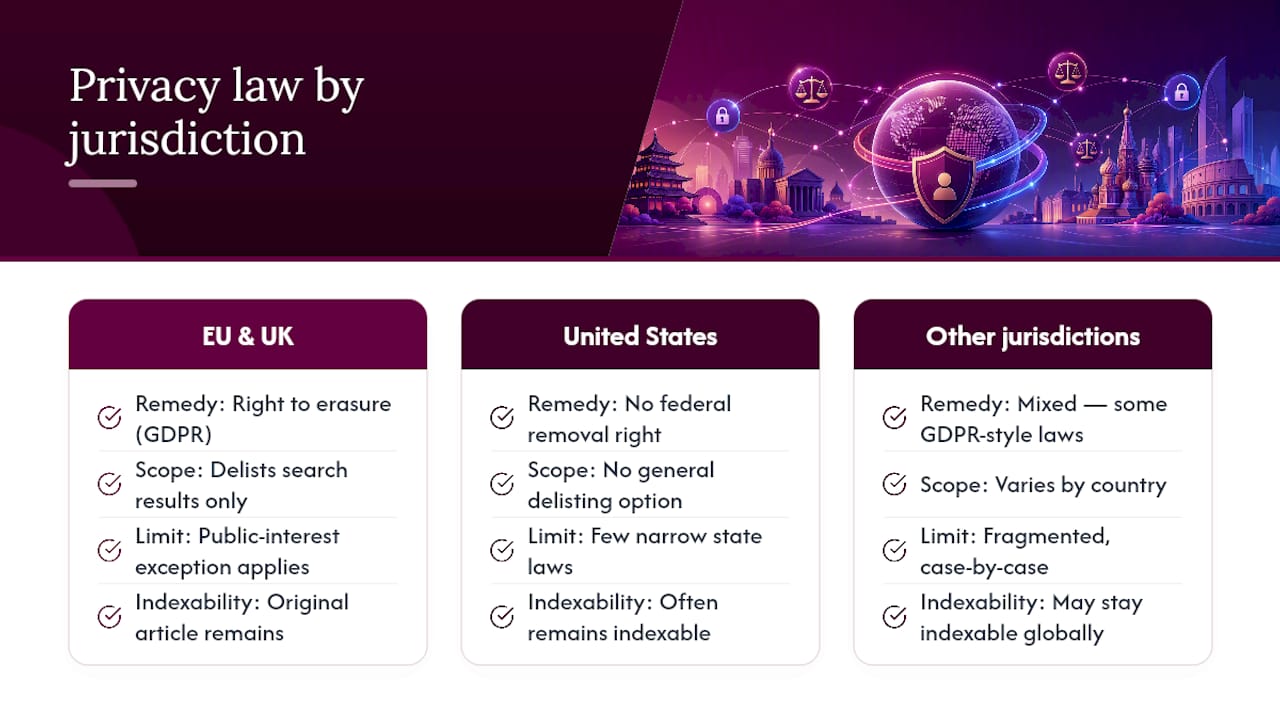
Privacy law is not one framework applied uniformly across every country, and this is where many people waste months pursuing a remedy their jurisdiction simply does not offer. UK and EU residents can invoke GDPR’s Right to be Forgotten, formally called the right to erasure, which lets you request that search engines delist certain results tied to your name. It is a narrower tool than it sounds. Delisting applies to the search result, not the original article, and it carries a public-interest exception that courts and regulators take seriously, particularly for public figures, business professionals, or anyone whose conduct touches matters the public has a legitimate interest in knowing.
The United States has no federal equivalent. A handful of states have passed narrower data-privacy statutes, but none grant a general right to demand removal of a negative news article simply because it is unflattering. This gap explains why so many removal requests that succeed in London stall completely when the same person tries the identical approach with a US-based publisher.
Beyond the EU and UK, the picture fragments further. Some jurisdictions have adopted GDPR-style frameworks; others have nothing comparable, and content once published there can remain permanently indexable regardless of what happens elsewhere. Where a story sits, who published it, and where the request is filed all change what is realistically achievable. Anyone assuming one legal strategy will work identically everywhere it appears is heading for a frustrating outcome, and that is precisely why professional guidance earns its cost in cross-border cases.
What does removing negative content actually cost?
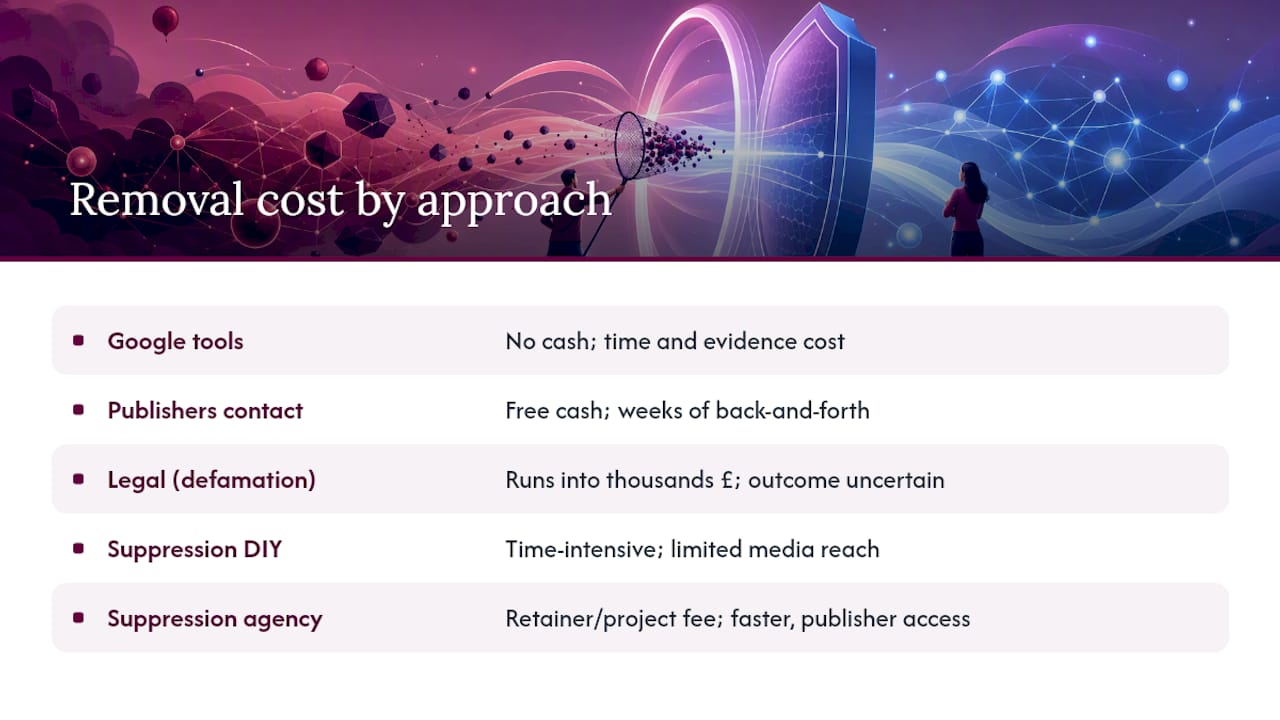
Costs vary enormously depending on which lever you pull, and the cheapest option is not always the fastest one. Filing Google’s own removal tools, the Outdated Content request, or the Right to be Forgotten form costs nothing directly, though the time spent gathering evidence and following up has a real opportunity cost, particularly for a business owner already stretched thin.
Contacting publishers directly is similarly free in cash terms but can consume weeks of back-and-forth, especially with smaller sites lacking a proper corrections process. Legal routes carry the steepest bill: a defamation claim typically requires solicitor engagement, correspondence, and potentially court filing fees, running into thousands of pounds before any judgment is reached, with no guarantee the claim succeeds or that the removed content stays down permanently.
Suppression work sits in the middle. Doing it entirely yourself, claiming profiles, writing content, and pursuing earned coverage, costs time rather than money, though most individuals and small businesses lack the media contacts and content production capacity to move quickly at scale. Hiring a specialist agency for reputation and profile management or crisis response carries a retainer or project fee, but it buys speed, existing publisher relationships, and a team that has already run this sequence for other clients. Weigh the cost of inaction too: a damaging article sitting on page one for a year can cost far more in lost business than a focused three-month engagement to push it down.
What actually matters most in reputation repair
Prioritise source removal wherever it is genuinely achievable. That single fix does more than any amount of suppression work, because a live original keeps feeding every crawler and AI system that finds it, no matter how buried the search result becomes.
Document every contact, every date, every piece of evidence, because you will need that record if a request stalls and needs escalating. Invest in positive authority-building in parallel rather than waiting for removal to finish first. Avoid public arguments with a publisher entirely; escalate to legal counsel only once there is a clear, demonstrable legal basis, not simply because the story stings.
— Anthony
How Antios Multi-Concepts can help you manage this
Antios Multi-Concepts approaches negative coverage the way this playbook lays it out: audit first, outreach second, suppression as the sustained third phase. Our reputation and profile management service starts with a full triage of your existing search footprint, sorting every problem URL into removable, deindexable, or suppressible before a single email goes out.

Where a story needs urgent handling, our crisis management team runs the publisher outreach and legal-referral sequence directly, so you are not drafting correction requests between client meetings. For the longer suppression phase, our media relations work builds the earned coverage that pushes older stories down the page, tailored for UK SMEs working with realistic budgets rather than enterprise-scale spend. Request a reputation audit through our public relations team to get a clear picture of where you stand and which route fits your situation before you commit to anything.
Sources
- How To Remove Negative Content From Google Before AI Answers Cite It
- 5 strategies to remove negative search results in 2026
- How AI changes online reputation management