

Run PR yourself until a significant raise or a high-stakes launch forces your hand. Founder-led commentary and data-led pitching cover most early visibility needs, but once you’re announcing funding, facing a reputational crisis, or hiring senior executives, a specialist agency earns its fee fast. Specialist agencies work with SMEs and startups at exactly that inflection point, offering managed PR support once DIY reaches its ceiling.
TL;DR:
- Specialist PR agencies become cost-effective when startups have recurring announcements or face reputational risks requiring strategic media relationships.
- Consistent, targeted PR efforts focusing on reactive commentary and small data campaigns generate backlinks, branded search growth, and measurable search authority.
- Real measurement of PR success hinges on backlinks, referral traffic quality, branded search volume, and search mention frequency, not just media coverage volume.
- A structured retainer from $5,000 to $15,000 per month is typical for funded startups seeking ongoing, SEO-integrated public relations programs.
- The best PR partners have sector-specific journalist relationships, can demonstrate impact on search metrics, and understand the startup stage realistically.
Table of Contents
- What does tech startup PR actually cover?
- Should you DIY your PR or hire an agency?
- High-impact PR tactics for tight startup budgets
- How do you measure whether PR is working?
- What does startup PR cost, and what do you actually get?
- How do you choose the right PR partner?
- Where the proof needs to sit
- How I approach a new startup PR engagement
- How Antios helps once DIY reaches its limit
- Sources
What does tech startup PR actually cover?
Public relations for startups splits into three working categories, and each earns its keep differently. Earned media is coverage you didn’t pay for: a journalist writes about your product because it’s genuinely newsworthy. Owned media is everything you control directly, your blog, your founder’s LinkedIn posts, your press releases. Shared media covers the messy middle: guest columns, podcast appearances, partner co-announcements.
The digital side of this matters more than most founders assume. Modern PR practitioners lean heavily on data-led pitching and reactive commentary, because both tend to earn backlinks that compound organic search visibility over time. That’s a different outcome from a one-off mention in a national paper that vanishes from relevance within a week.
Here’s what good tech startup PR actually delivers, translated into business terms:
- Search equity: backlinks from reputable outlets improve domain authority and organic rankings, not just brand awareness
- Fundraising credibility: investors Google founders before meetings, and a thin or absent media footprint reads as a red flag
- Recruiting leverage: senior candidates weigh press coverage when judging whether a startup is stable enough to join
- Partner introductions: PR coverage often opens doors to business development conversations that cold outreach never reaches
- Crisis insurance: a startup with existing media relationships handles a reputational hit far better than one starting from zero
None of this happens from a single press release. It happens from a consistent, monitored programme, which is precisely why the timeline question matters so much for founders deciding how to resource it.
Should you DIY your PR or hire an agency?
The honest answer depends on stage, not preference. Here’s a practical checklist for where most startups sit and what each stage can realistically sustain:
- Pre-product or pre-seed: founder-led only. You don’t have news yet, so focus on relationship-building with relevant journalists and building your own commentary track record.
- Seed stage, no major news pending: still mostly DIY, supplemented by a freelance PR consultant for specific projects like a product launch.
- Post-raise or scaling with recurring announcements: this is where a retainer agency starts paying for itself, because the volume and stakes of communications outstrip what a founder can manage alongside running the business.
- Entering new markets or hiring C-suite: bring in specialist support regardless of size, since reputational risk and message consistency both increase sharply.
Three moments should trigger a hire conversation immediately, no matter your stage: a funding announcement, any reputational event with legal or public safety implications, and hiring a senior executive whose background needs careful positioning. Outside those triggers, founders using free tools like Connectively and Google Alerts can produce measurable coverage in niche trade outlets within a focused 60-day push, no agency required.
High-impact PR tactics for tight startup budgets
You don’t need a large budget to get real coverage. You need discipline about which motion you’re running and the patience to run it properly for several weeks before judging results.
Reactive commentary is the highest-return tactic available to founders with no PR history at all. When news breaks in your sector, journalists on tight deadlines need a quotable expert fast. Founders who respond within hours, backed by a specific data point or a clear opinion, build journalist relationships faster than those sending long-lead pitches that sit in an inbox for weeks. Speed and evidence both matter here: a vague “happy to comment” email gets ignored, but a two-sentence quote with a number attached often gets used verbatim.
Small data campaigns work because journalists need something concrete to hang a story on. This doesn’t require a research department. A survey of 200 customers, an analysis of your own usage data, or even a well-reasoned estimate based on public figures can become the hook for a piece. The trick is packaging the finding as a standalone fact a reporter can lift directly, rather than burying it in three paragraphs of context.
Unlinked mention outreach is the most underused tactic in the startup playbook. Set a Google Alert for your company name and check it weekly. When a publication mentions you without linking back, a polite email asking them to add a link converts surprisingly often, and it’s essentially free backlink recovery.
Structured announcement pages help both journalists and AI tools extract your facts correctly. Lead with the who, what, and number, in that order, before any narrative framing. A press release buried in adjectives gets skimmed and misquoted; one that states the funding amount, the investors, and the use of funds in the first two lines gets copied accurately.
Pro Tip: Pick one motion, reactive commentary or data campaigns, and commit to it for a full quarter before adding a second. Founders who spread thin across five tactics at once usually see nothing land, because none of them get the repetition needed to build journalist trust.
AI tools can speed up drafting, ideation, and monitoring, but they shouldn’t touch the actual pitch to a journalist or a spokesperson’s live quotes. Responsible use with human oversight keeps the efficiency gains without the risk of a generic-sounding pitch landing in a reporter’s inbox alongside fifty others.
How do you measure whether PR is working?
Impressions and reach numbers feel good but tell you almost nothing about business impact. The KPIs that actually matter are the ones tied to search and revenue outcomes.
- Branded search volume: track monthly searches for your company name; a sustained increase after a campaign signals real audience awareness, not just a vanity spike
- Referral traffic quality: look at time on site and conversion rate from PR-driven visitors, not just raw visitor count
- Backlinks earned: count both volume and the authority of linking domains, since one strong link often outweighs ten weak ones
- Domain authority movement: this shifts slowly, so judge it over quarters, not weeks
- AI citation frequency: check whether tools like ChatGPT or Perplexity mention your company when users ask sector-relevant questions, an increasingly important signal as search behaviour shifts
A funding announcement campaign can realistically produce 15 to 30 backlinks and a measurable branded-search uptick in the weeks that follow coverage, which gives you a concrete benchmark to judge whether a campaign actually landed.
Set a monthly reporting cadence at minimum, quarterly for board-level summaries. A minimalist dashboard needs just four rows: branded search trend, new backlinks this period, referral traffic quality, and a running list of placements with outlet authority noted. Anything more elaborate becomes reporting for its own sake.
What does startup PR cost, and what do you actually get?
Budget determines both scope and speed, and understanding the bands helps you avoid either overpaying for basic output or underfunding a campaign that needed more runway.
- DIY ($0 to $500 per month): founder-led outreach using free monitoring tools, realistic for niche trade coverage
- Freelance or project ($500 to $1,500): a single campaign, such as a product launch or a specific data story, executed by a consultant
- Boutique retainer ($3,000 to $7,000 per month): ongoing media relations, reactive commentary support, and ad hoc campaigns
- Funded-startup digital PR retainer ($5,000 to $15,000 per month): full programme with SEO-integrated measurement, typically for post-raise companies
Retainers beat one-off projects for compounding results. Six months is the realistic minimum commitment before you see the search and authority gains stack meaningfully, with the first two months spent on positioning and relationship-building before the compounding phase kicks in. For a 90-day funding or launch engagement, scope it as four weeks of foundation and messaging, followed by eight weeks of active pitching and follow-up.
How do you choose the right PR partner?
Three checks matter more than any glossy pitch deck: does the agency have genuine relationships with journalists who cover your sector, can they show measurement that ties coverage to search or business outcomes, and do they understand your stage well enough to scope realistically rather than overselling.
Ask these ten questions on a discovery call before signing anything:
- Which named journalists in our sector have you placed stories with in the last six months?
- Can you show a case study with backlinks or branded search movement, not just clip counts?
- How do you handle reactive commentary requests, and how fast is your typical turnaround?
- What does your reporting dashboard actually track?
- Who specifically will work on our account, and what’s their sector background?
- How do you prepare spokespeople before media interviews?
- What’s your process if a pitch gets no response after a week?
- How do you scope a funding announcement versus an ongoing retainer?
- Can we speak to a current client in a comparable stage or sector?
- What happens if we need to pause or exit the retainer early?
Pro Tip: If an agency can’t name a single journalist relevant to your sector within the first five minutes of a call, that’s a red flag worth ending the conversation over. Sector relevance beats generalist enthusiasm every time.
Where the proof needs to sit
Antios Multi-Concepts UK Limited works across PR campaign management, crisis communications, content creation, and digital marketing for UK SMEs, with client testimonials pointing to measurable visibility gains delivered on realistic budgets. Anthony’s specific credentials and named case studies from past startup engagements sit in Antios’s internal client records and should be added here once cleared for publication. Typical retainer structures for startups follow the boutique-to-funded bands outlined above, scoped after an initial discovery call rather than sold as a fixed package upfront.
How I approach a new startup PR engagement
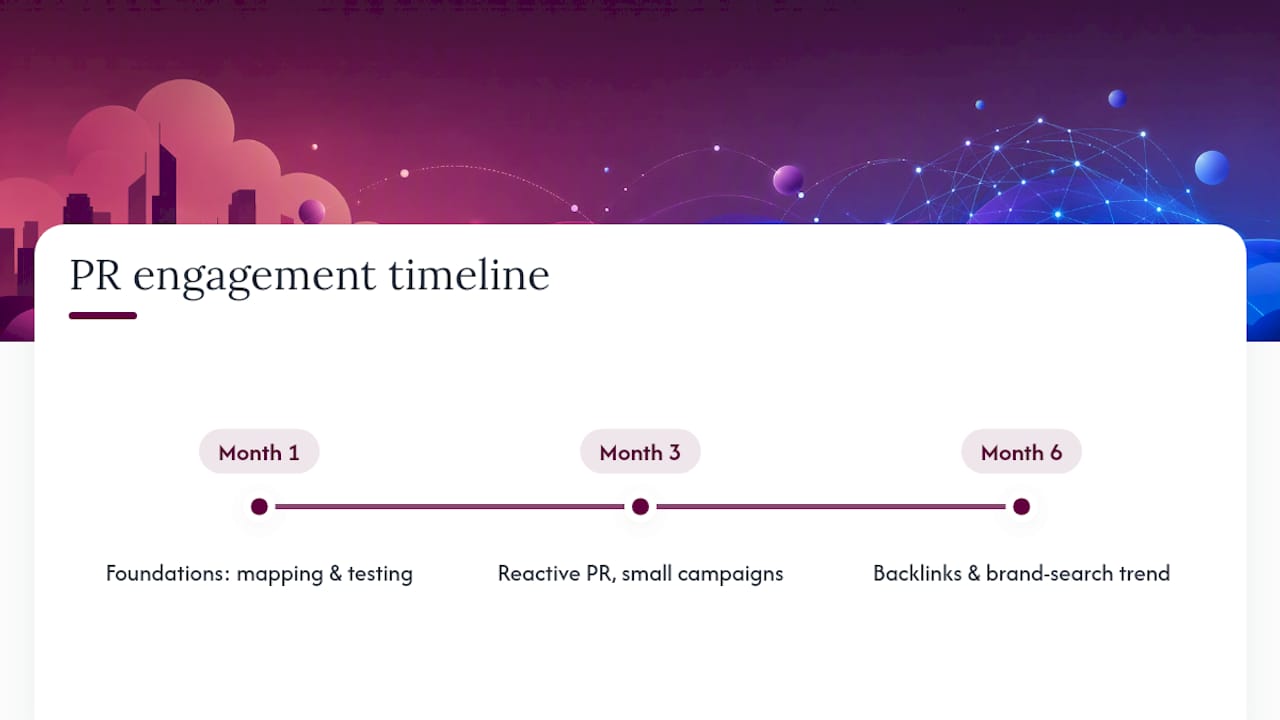
My first month is foundation work: journalist mapping, message testing, and setting a baseline for branded search. Month three is where reactive commentary and small data campaigns start generating placements. By month six, if the programme’s working, backlinks and branded search should show a visible trend rather than isolated spikes.
I balance short-term wins against long-term visibility deliberately, because a founder chasing only quick hits burns relationships that would have compounded. On a discovery call, expect direct questions about your stage, your news pipeline, and whether you’re actually ready for the attention PR brings.
— Anthony
How Antios helps once DIY reaches its limit
Specialist agencies can be a practical alternative to building an internal PR function from scratch once founder-led commentary stops keeping pace with your news pipeline. Where a full internal hire means recruiting, training, and months of ramp-up, a startup-focused retainer gives you journalist relationships and reactive-commentary capacity from week one.
The service maps directly onto what this guide covers: media relations for reactive commentary and spokesperson preparation, and a public relations retainer for founders past the DIY stage who need measured, ongoing coverage tied to search outcomes. A discovery call often covers your current news pipeline, your stage, and which pricing bands actually fit your situation, with no generic package pushed regardless of fit. If a funding announcement, senior hire, or new market entry is on your calendar in the next quarter, book that call now and get a scoped proposal before the announcement date locks in.
Sources
- Digital PR strategies for startups & SMBs in 2026 – Shiny
- Digital PR for Funded Startups: The Post-Raise Playbook
- AI marketing strategies for startups — Salesforce