

Total trade between the UK and South Africa reached £12.6 billion by the close of 2025, yet many British entrepreneurs still view the continent through a lens of uncertainty. You likely recognise the immense potential for growth, but perhaps you’re held back by the fear of economic instability or a lack of reliable local networks. It’s a common challenge for small businesses; whilst the ambition to scale is there, the practical path to doing business in Africa from UK headquarters often feels obscured by cultural complexities and regulatory hurdles.
This guide serves as your strategic roadmap, offering the clarity needed to turn these challenges into a competitive advantage. We provide a clear, step-by-step framework for market entry that prioritises reputation management and authentic connection. You will gain insights into the 2026 trade environment, learn to master the nuances of local business etiquette, and discover how a dedicated ally like Connect Africa can help you establish a secure, professional presence in these high-growth markets.
Key Takeaways
- Understand how the African Continental Free Trade Area (AfCFTA) is creating unprecedented opportunities for British exporters to reach a rapidly expanding middle-class consumer base.
- Learn to conduct granular market analysis that identifies the most viable regional entry points whilst successfully navigating the complexities of doing business in Africa from UK headquarters.
- Evaluate diverse market entry strategies, including digital-first approaches and local partnerships, to determine the most efficient and compliant path for your specific business model.
- Develop a bespoke communication and PR plan designed to establish long-term brand authority and trust with local stakeholders, influencers, and government bodies.
- Discover how the Connect Africa project provides a specialised, cost-effective bridge for SMEs to access expert market insights and reputation management without the need for an immediate on-the-ground presence.
Why UK SMEs are Prioritising Doing Business in Africa in 2026
The traditional reliance on European trade routes has evolved into a quest for broader resilience. UK small businesses are increasingly looking south, recognising that Africa is no longer just a destination for raw materials but a sophisticated hub of innovation and middle-class consumption. By 2026, the trade landscape between the UK and Africa has matured into a partnership of mutual economic growth rather than the donor-recipient models of the past. This shift allows SMEs to find high-value niches where their specific expertise is not just welcomed but actively sought.
The African Continental Free Trade Area (AfCFTA) has fundamentally changed the logic of doing business in Africa from UK offices. By reducing internal tariffs and harmonising regulations across the continent, AfCFTA allows British exporters to view the region as a collection of integrated economic blocks. This integration, combined with the UK’s Developing Countries Trading Scheme (DCTS), provides a stable framework for long-term investment. Small businesses can now leverage preferential tariffs on over 90% of product lines in many African nations, making price points more competitive than ever before.
At Antios, we believe that expansion is not a transaction; it’s a communication strategy. This is the philosophy behind our “Connect Africa” project. We’ve established this initiative to serve as the foundation for market entry, ensuring that UK SMEs can build the brand authority and local trust necessary to thrive. Without a strategic communication plan, even the best products can struggle to gain traction amongst local stakeholders.
The Economic Potential of Emerging Hubs
Growth isn’t uniform across all fifty-four nations. However, the trends in East and West Africa are particularly compelling for those seeking high-growth environments. For a pan-African economic overview, one must look at how GDP is diversifying away from traditional sectors. UK SMEs are finding success in several key areas:
- Fintech and Services: Nigeria and Kenya lead the world in mobile payment adoption, creating a massive demand for supporting software and professional services.
- Agri-tech: British expertise in sustainable farming and supply chain efficiency is vital for food security initiatives across the continent.
- Renewable Energy: Decentralised solar and wind projects offer massive potential for engineering and consultancy firms.
Overcoming the “Risk Perception” Gap
Many business owners hesitate because they perceive the continent as inherently unstable. Whilst economic shifts occur, the actual risk is often significantly lower than the perceived risk for those who possess accurate data. Market analysis is the vital tool that bridges this gap. SMEs are often more agile than their multinational counterparts; they can pivot quickly and build more personal, authentic relationships with local partners. Success in doing business in Africa from UK bases depends on moving past these stereotypes to see the grounded reality of a vibrant, professional marketplace. By focusing on evidence-based entry, you can mitigate risks and focus on the tangible growth opportunities available.
Step 1: Conducting Detailed Market Analysis and Cultural Research
Success in doing business in Africa from UK bases requires a shift from macro-economic observation to micro-market intelligence. Whilst high-level reports provide a useful starting point, they often fail to capture the pulse of local consumer behaviour. You cannot treat a continent of fifty-four nations as a single entity. Each region possesses distinct regulatory frameworks, linguistic nuances, and consumer preferences that dictate whether a product thrives or falters. Accurate research must move beyond desk-based data to include the lived realities of your target audience.
Antios Multi-Concepts helps SMEs move beyond basic research by providing “boots on the ground” insights. Our market analysis structure focuses on identifying the specific regional entry point that aligns with your industry. Whether you are targeting the tech-savvy youth of Lagos or the agricultural innovators in Nairobi, your strategy must be grounded in reality rather than assumptions. Whilst macro-level data informs your general direction, including the 2026 updates to the UK’s Developing Countries Trading Scheme (DCTS), the UK government export guidance serves as a vital baseline for logistical compliance.
Cultural Intelligence: The Key to Successful Negotiation
Business cultures in many African nations are deeply rooted in personal relationships and mutual trust. It’s rarely about the quickest transaction; it’s about the strongest partnership. For instance, navigating business etiquette in Nigeria or Kenya involves a level of social engagement that British SMEs might find unfamiliar. You must avoid “parachute” entries where a brand arrives without local context. Building authority amongst local stakeholders requires patience and a commitment to understanding the social fabric of your target market. This cultural fluency is what separates a one-off export from a sustainable international presence.
Identifying Your Target Demographic
The burgeoning middle class in urban centres presents a significant opportunity, but rural markets shouldn’t be ignored if your product solves a specific infrastructure challenge. We recommend using digital marketing data to test market appetite before a full launch. By creating targeted content, you can measure brand resonance and adjust your tone to suit local tastes. This data-driven approach ensures your entry is both cost-effective and strategic. If you’re unsure where to start, our team can help you conduct bespoke market analysis to find your ideal niche in this vibrant landscape.
Step 2: Choosing Your Entry Strategy and Navigating Regulations
Once your market research has identified a viable region, the focus must shift to the operational vehicle for your expansion. doing business in Africa from UK headquarters requires a balanced assessment of risk, control, and local agility. For many SMEs, the choice isn’t merely logistical; it’s a strategic decision that defines how your brand is perceived by local stakeholders and government bodies alike. Moving from theory to practice involves selecting a model that matches your current capacity whilst allowing for future scalability.
Direct exporting allows you to maintain high levels of quality control whilst testing demand with minimal physical overhead. However, this approach can sometimes limit your ability to respond to local market shifts in real-time. Conversely, digital-first entry strategies, leveraging e-commerce and remote service delivery, have become increasingly popular in 2026, allowing brands to build a digital footprint before committing to a physical presence. The Department for Business and Trade (DBT) offers various support mechanisms to help you navigate these initial steps, providing resources that bridge the gap between British ambition and African opportunity.
Direct Entry vs Local Partnerships
Establishing a local subsidiary offers the highest level of market integration but comes with specific regulatory demands. For example, as of 2026, companies with foreign participation in Nigeria must have a minimum authorised share capital of NGN 100,000,000.00. This capital requirement makes local partnerships an attractive alternative for many UK SMEs. A well-vetted partner provides immediate market access and cultural intelligence, but they also represent your brand’s integrity. Reputation and profile management are essential during the vetting process; you must ensure your partner’s business ethics align with your own to avoid long-term profile damage.
Navigating Trade Agreements and Taxes
The UK’s Developing Countries Trading Scheme (DCTS) is a cornerstone of current trade, providing preferential tariffs to 65 countries. This scheme simplifies the rules of origin, making it easier for your goods to qualify for 0% import tariffs in many jurisdictions. However, you must also account for local corporate tax environments. In 2026, corporate tax rates remain distinct across the continent: South Africa stands at 27%, Kenya at 30%, and Nigeria at 30% for large companies, whilst offering 0% for small companies with turnover under NGN 100 million. Understanding these variations is vital for maintaining your strategic advantage.
Managing the repatriation of profits and currency fluctuations requires a methodical approach to financial planning. Whilst DCTS reduces the cost of goods, the tax implications for services are often governed by specific bilateral agreements. Typically, UK-to-Africa services are subject to local withholding taxes, which can range from 5% to 15% depending on the country and the existence of a double taxation treaty. Success depends on understanding these granular details before your first transaction occurs.
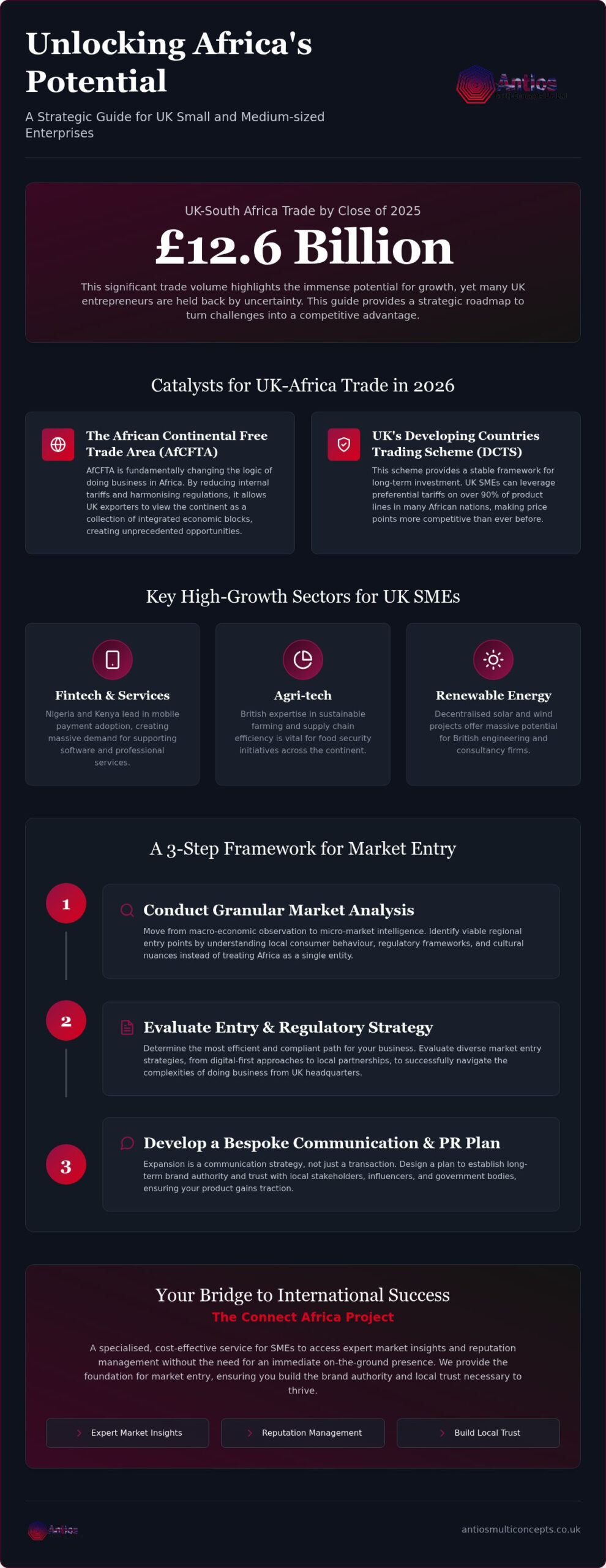
Step 3: Building a Strategic Communication and PR Plan
Logistics and tax compliance form the skeleton of your expansion, but communication is the heartbeat. When doing business in Africa from UK offices, many SMEs mistakenly apply British PR templates to a completely different cultural fabric. Standard press releases often fall flat if they lack local resonance. You need a strategic communication plan that prioritises storytelling over simple announcements to build genuine brand authority. In many regions, business is personal; your communication must reflect a commitment to the local community rather than just a desire for market share.
Traditional UK tactics often fail because they overlook the communal and relationship-driven nature of African business ecosystems. Establishing authority amongst local stakeholders requires a more nuanced approach than mere advertising. It’s about demonstrating value and alignment with local economic goals. Digital PR plays a vital role here. By securing placements on regional news sites, you improve your search visibility and ensure your brand appears credible when local partners conduct their due diligence. This digital footprint acts as a silent ambassador for your business, working 24/7 to build trust before you even enter a boardroom.
Media Relations and Local Influence
Building trust requires a focus on earned media. In cities like Lagos, Nairobi, and Johannesburg, a recommendation from a respected local journalist or industry influencer carries far more weight than a paid banner ad. People value authenticity. Antios manages this proactive outreach directly from the UK, ensuring your message reaches the right desks without you needing an on-the-ground press office. We bridge the gap by translating your corporate values into local narratives that resonate with regional audiences whilst maintaining your core brand identity.
Crisis Communication and Reputation Protection
Operating in unfamiliar territories brings inherent risks of misunderstanding. A single cross-border miscommunication or a failure to account for local social nuances can damage your reputation before you’ve even fully launched. This is why crisis management and reputation protection are non-negotiable. You need a response strategy that accounts for political or social shifts in real-time. Protecting your SME’s profile requires a steady hand and a deep understanding of local sensitivities. A monthly PR retainer provides the ongoing monitoring necessary to catch issues before they escalate, ensuring your reputation remains untarnished as you scale.
If you’re ready to build a presence that lasts, our team can help you develop a bespoke Public Relations Communications strategy tailored for your target African market.
Leveraging Connect Africa: Your Bridge to International Success
Establishing a presence in a new continent requires more than just ambition; it demands a partner who understands the ground reality. At Antios Multi-Concepts, we developed the “Connect Africa” project specifically to address the barriers UK small businesses face when doing business in Africa from UK headquarters. Our objective is to serve as a strategic bridge, providing the local expertise and communication networks that were previously only accessible to major multinationals. We believe that the size of your business shouldn’t limit the scale of your international aspirations.
We provide cost-effective market entry solutions by leveraging a vast network of African market analysts and PR specialists. This means you don’t need a physical office in Lagos or Nairobi to begin building your profile. Instead, you can access bespoke intelligence and reputation management services that are scaled to fit your specific business needs. Our specialists don’t just provide data; they provide vital context, helping you understand why a certain consumer behaviour is prevalent in one city but not another. The path from initial interest to your first genuine business lead is shortened when you have a mentor who has already paved the way.
Bespoke Support for SME Expansion
Our project-based consulting model is designed to respect the financial constraints of smaller enterprises. We don’t believe that high-level strategic advice should be reserved for those with unlimited budgets. For example, we’ve successfully connected UK technical talent with emerging opportunities in West African tech hubs by aligning their digital presence with local market demands. This focused approach ensures your resources are spent on activities that yield tangible results. If you’re ready to move beyond research, you can book a market analysis consultation with our London team to begin mapping your specific trajectory.
- Phase 1: Initial London-based consultation to define goals.
- Phase 2: Bespoke market analysis and risk assessment.
- Phase 3: Strategic PR and communication rollout.
- Phase 4: Lead generation and local partnership facilitation.
The Antios Advantage: PR, Crisis, and Market Entry
The true advantage of working with us lies in our holistic approach. We integrate your existing UK digital marketing efforts with your African expansion goals, ensuring a consistent brand voice across borders. By aligning your doing business in Africa from UK strategy with our local communication networks, you gain a level of strategic advantage that is typically reserved for larger corporations. Our commitment to the democratisation of high-level professional services ensures that your SME can compete on a global stage with confidence.
Expansion is a journey of transformation, and we’re here to ensure your reputation remains your strongest asset throughout the process. Now is the time to turn your international aspirations into a tangible roadmap. Explore how Connect Africa can scale your business and take the first step towards a sustainable future in the world’s most vibrant emerging markets.
Transforming Your International Ambition into Reality
The transition from a domestic focus to an international presence requires a shift in both strategy and mindset. We’ve detailed how accurate market analysis and cultural fluency serve as the essential pillars for any UK small business looking to scale southwards. Success depends on moving beyond surface-level data to embrace authentic local connections and strategic communication. Whilst the complexities of trade regulations and regional nuances exist, they are manageable hurdles for those who approach them with a clear roadmap and a dedicated ally.
Doing business in Africa from UK bases is no longer a privilege reserved for large corporations. Through our specialised Connect Africa project, we provide the expert market analysis and London-based strategic PR expertise needed to democratise these opportunities for SMEs. We’re committed to acting as your transformative partner, ensuring your reputation remains secure as you navigate new territories. It’s time to move from planning to action. Begin your African expansion with our Connect Africa project and discover the growth potential awaiting your brand in 2026. We look forward to helping you build a legacy that spans continents.
Frequently Asked Questions
Is it safe for a UK small business to do business in Africa?
Safety is largely a matter of thorough preparation and proactive risk mitigation. Whilst political or economic shifts occur, many UK SMEs find that the actual risk is lower than the perceived risk once they possess accurate market intelligence. Using professional market analysis helps you identify stable regions and high-growth sectors, ensuring your expansion is grounded in data rather than assumptions. Diligence and local insight are your best protections against instability.
Which African countries are easiest for UK businesses to enter in 2026?
South Africa, Nigeria, and Kenya remain the most accessible hubs for British enterprises due to established trade links and the UK’s Developing Countries Trading Scheme (DCTS). South Africa, in particular, saw total trade with the UK reach £12.6 billion by the end of 2025. These nations offer mature legal frameworks and a high demand for UK services, making them ideal starting points for doing business in Africa from UK headquarters.
Do I need a physical office in Africa to trade there?
A physical office isn’t a prerequisite for market entry in the digital age. Many SMEs successfully use a digital-first strategy or work through local partners to manage on-the-ground operations. This approach allows you to test market appetite and build brand authority without the immediate overheads of international property. Local partnerships often provide the necessary presence whilst you maintain strategic control and keep your core operations based in Britain.
How much does it cost to start doing business in Africa from the UK?
Costs vary significantly based on your chosen entry strategy and the specific country’s regulations. For example, as of 2026, companies with foreign participation in Nigeria must have a minimum authorised share capital of NGN 100,000,000.00. You should also budget for essential services like market analysis and reputation management. Avoid fixed estimates; instead, focus on a phased investment plan that scales as your local revenue and market confidence grow.
What are the main cultural differences in African business etiquette?
Business in many African nations is built on a foundation of personal trust and long-term relationships. Unlike the often transactional nature of UK business, negotiations here frequently involve social engagement and a deep respect for hierarchy. Understanding these nuances is vital; a failure to observe local etiquette can damage your brand’s profile before a partnership even begins. Patience, earnest communication, and a commitment to mutual value are your most valuable assets.
How can a PR agency help with international business expansion?
A specialised PR agency builds the brand authority and local trust required to thrive in a new market. They manage your profile amongst local stakeholders, handle media relations in cities like Nairobi or Lagos, and provide essential crisis management. By translating your UK corporate values into narratives that resonate locally, an agency ensures your brand isn’t viewed as an outsider but as a committed, reliable partner for the long term.
What is the Connect Africa project by Antios Multi-Concepts?
Connect Africa is a specialised project designed to democratise international expansion for UK SMEs. It provides a cost-effective bridge to African markets through bespoke market analysis and strategic Public Relations Communications. The project’s goal is to empower smaller entities with the same level of professional intelligence and reputation management typically reserved for large corporations, facilitating a smoother, more secure entry into some of the world’s fastest-growing economies.
Can I manage my African business operations entirely from the UK?
Managing your operations remotely is entirely possible, especially when doing business in Africa from UK offices with the support of a strategic ally. Whilst digital tools allow you to oversee marketing and communications, having a reliable local partner or a specialised consultant helps bridge the cultural and operational gaps. This hybrid model provides the oversight you need whilst ensuring your brand maintains an authentic, responsive presence on the ground.