

Small business reputation management means actively monitoring and shaping how your company appears across reviews, search results, social media, and press. Start with three moves: claim every listing on Google, Yelp and industry-specific sites, set up basic monitoring, and reply to any outstanding reviews within a week. Do this consistently and you should see visible tone shifts within weeks, with measurable rating and traffic gains typically following within three to six months.
TL;DR:
- Consistently claim and monitor your online listings and reviews on Google, Yelp, and sector-specific sites using free tools like Google Alerts to maintain visibility.
- Push for recent reviews by asking satisfied customers immediately after positive interactions through preferred channels without incentivizing or fabricating feedback.
- Respond publicly to all reviews within 48 hours using a three-step framework: thank, acknowledge, and propose next steps, personalizing each reply to build trust.
- Proactively create content and seek local media coverage to strengthen your reputation and improve local search rankings through reviews, backlinks, and public stories.
- Establish a clear reputation management process owned organization-wide, with regular oversight, and consider partnering with a dedicated PR service to ensure consistency and crisis readiness.
Table of Contents
- What does “online reputation” actually cover?
- How do you monitor your reputation without hiring a team?
- How do you get more genuine reviews consistently?
- What’s the right way to respond to reviews?
- How can proactive PR and content build a stronger reputation?
- What do you do when a reputation crisis hits?
- How do you measure whether reputation management is working?
- What mistakes do small businesses make most often?
- How does customer service double as reputation management?
- Can local SEO strengthen your reputation, and how?
- How do you use social proof in your marketing effectively?
- What does a working reputation checklist actually look like?
- How can Antios support your reputation management?
- Sources
What does “online reputation” actually cover?
Most business owners think reputation means Google reviews. It is much broader than that, and missing the other pieces is why reputation work often feels like it’s not working.
Your reputation lives across five overlapping signals, and each one carries different weight with buyers and with search engines:
- Review platforms — Google Business Profile, Trustpilot, Yelp, and sector-specific sites like TripAdvisor or industry directories.
- Search engine results pages — what appears when someone types your business name, including news snippets, complaint forums, and old social posts.
- Social mentions — tags, comments, and shares that never touch a formal review site but shape perception all the same.
- Press coverage — local news, trade publications, and any journalist write-ups, good or bad.
- Directory listings — Companies House-style registries, trade association pages, and local business directories that often rank surprisingly well.
Recency beats volume in almost every case. A business with 40 reviews all dated within the last six months reads as more trustworthy than one with 400 reviews, most from three years ago, because buyers weight recent feedback more heavily than a large historic archive. Product quality and customer service ultimately drive all of it. No amount of review management fixes a business that consistently disappoints people.
How do you monitor your reputation without hiring a team?
You do not need software subscriptions to start. Free monitoring covers most small businesses adequately for the first several months.
Set up Google Alerts for your business name, your owner’s name if they’re public-facing, and common misspellings. Pair that with a weekly manual check of your Google Business Profile, Trustpilot, and any sector site relevant to you. Wharton’s small business guidance recommends exactly this: claim your profiles, set alerts, and designate one person as the accountable owner of the process. Ambiguity about who checks what is the fastest way for a bad review to sit unanswered for a month.
A practical weekly routine looks like this:
- Daily: scan alert emails for anything urgent (five minutes).
- Weekly: check all review platforms and reply to anything new (20 to 30 minutes).
- Monthly: summarise trends, ratings movement, and recurring complaint themes for the owner or manager.
Move to a paid dashboard tool once you’re managing more than two or three platforms regularly, or once checking manually starts eating into time you’d rather spend serving customers. Most owners find DIY monitoring takes a few hours a week once the routine is established, which is manageable for most solo operators but worth delegating as the business grows.
Pro Tip: Set your Google Alert to “as it happens” rather than a daily digest for your exact business name. A three-day delay on a viral complaint can be the difference between a quiet fix and a public escalation.
How do you get more genuine reviews consistently?
The businesses with the strongest reputations rarely have the best product. They simply ask for reviews more consistently than their competitors, and they ask at the right moment.
- Ask immediately after a positive interaction — right after a delivery, a completed job, or a compliment given in person. Enthusiasm fades within days.
- Use the channel your customer already prefers — a text message with a direct review link converts better than a generic email footer for most consumer-facing businesses.
- Keep the ask short and specific: “Thanks for choosing us today. If you had a good experience, a quick Google review would really help other local customers find us — here’s the link.” Avoid vague requests like “let us know what you thought,” which produces fewer responses and vaguer ones.
- Build the ask into a process, not a one-off campaign. A repeatable system built around timing, channel, and an easy link produces steadier, more recent reviews than a single push to your customer list.
- Never incentivise or fabricate reviews. Google’s guidelines explicitly prohibit incentivised reviews, and platforms actively remove clusters of reviews that look purchased or coordinated. The short-term rating boost is never worth the platform penalty or the reputational risk if discovered.
Steady, ongoing requests beat occasional bursts every time, because recency consistently outweighs sheer archive size in how buyers judge trustworthiness.
What’s the right way to respond to reviews?
Every reply you write is really written for the next hundred people who read it, not just the reviewer. Treat each response as a small public demonstration of how your business handles problems, because that’s exactly how prospective customers read it.
Use a simple three-step public framework: thank the reviewer, acknowledge specifically what they raised, and state the next step. Responding at all measurably helps: hotels that replied to reviews saw average ratings rise by roughly 0.12 stars compared with those that stayed silent. That’s not a dramatic number on its own, but compounded across dozens of reviews it shifts your overall average meaningfully.
- Positive review: “Thank you, Sarah — really glad the fitting went smoothly and the team could sort the sizing on the spot. We’ll pass this on to them directly.”
- Neutral or mixed review: “Thanks for the honest feedback. We’d like to understand more about the delay you mentioned. Could you drop us a message so we can look into it properly?”
- Negative review: “We’re sorry this wasn’t the experience you expected. We’d like to put this right. Please contact us directly at [phone/email] so we can resolve it.”
Move detailed disputes offline quickly, but always close the loop publicly once resolved: “Update: we spoke with the customer and resolved the issue.” That final line matters more than the apology itself, because it proves resolution, not just politeness.
Personalised replies that reference specific details consistently outperform templated language, according to Wharton’s research on small business reputation habits. Generic copy and paste responses read as dismissive even when the sentiment is right, and search engines increasingly reward businesses that engage substantively with reviews when ranking local listings.
Pro Tip: Never argue with a reviewer in the reply. Even if they’re factually wrong, a defensive public reply damages you more than the original review did.
How can proactive PR and content build a stronger reputation?
Waiting for reviews to accumulate is passive. The stronger move is actively creating content and coverage that outranks or outweighs anything negative sitting in your search results.
Customer stories and short case studies published on your own site give search engines fresh, positive content tied to your brand name, and they double as trust signals for prospects doing due diligence. Local press outreach works particularly well for SMEs because local journalists are often actively looking for community stories, and a well-pitched angle about an anniversary, a hire, or a community event can land coverage that a generic press release never would.
Practical moves worth prioritising:
- Pitch a short expert comment to a trade publication when a relevant news story breaks in your sector.
- Sponsor or tie into a local event and secure a mention in event coverage.
- Publish short written case studies from satisfied clients, with their permission, on your own website.
- Fix the operational sources of complaints directly: unclear returns terms, inconsistent quality checks, or slow response times generate more negative reviews than almost anything else.
Reputation management works best as a proactive, organisation-wide habit rather than a reactive scramble, and content plus operational fixes are the two levers that shift the underlying reality, not just its public perception.
What do you do when a reputation crisis hits?
A single bad review is manageable. A viral complaint or negative press story needs a faster, more structured response, and the first hour matters more than the next week.
- Stabilise first. Do not respond publicly until you have the facts straight. A rushed, inaccurate reply is worse than a short delay.
- Appoint one lead. One person coordinates the response across all channels. Mixed messaging from different staff members is the most common way small crises become bigger ones.
- Gather every fact before drafting anything: what happened, who was affected, and what you can concretely offer.
- Draft one consistent public message and use it, adapted in tone, across every platform where the issue is being discussed.
- Call in legal or a PR specialist if the complaint involves safety, discrimination, financial loss, or anything likely to attract journalist attention.
- Follow up publicly once resolved, and keep monitoring for a further two to four weeks in case the story resurfaces.
Pro Tip: Draft a one-page crisis holding statement template before you ever need one. Trying to write your first public response while a story is actively spreading is how avoidable mistakes happen.
How do you measure whether reputation management is working?
Track five numbers and you’ll know within a quarter whether your effort is paying off: average star rating, total review volume, sentiment trend (positive versus negative tone over time), average response time, and how your business appears on the first page of search results for its own name.
Report on a simple cadence: check alerts daily, summarise trends weekly, and review the full picture monthly, with a deeper quarterly check against your original goals.
Businesses that reply consistently to reviews see average ratings climb by around 0.12 stars, a modest but real shift that compounds as review volume grows.
- Weeks 1 to 4: tone of new reviews improves, response backlog clears.
- Months 2 to 3: average rating begins to move measurably, search snippets start reflecting recent activity.
- Months 3 to 6: visible improvement across most core metrics, assuming consistent activity throughout.
What mistakes do small businesses make most often?
Most reputation damage is self-inflicted, not caused by the original complaint.
- Ignoring reviews entirely, which reads as indifference even when the business is simply busy.
- Using generic, defensive templates that make customers feel processed rather than heard.
- Buying reviews or gaming platforms, which risks account suspension and destroys trust if discovered.
- Having no internal protocol, so responses depend entirely on who happens to check that week.
- Over-automating responses without human review, producing replies that miss context or tone entirely.
How does customer service double as reputation management?
Every customer service interaction is a reputation event whether or not it ever becomes a public review. The quality of how you handle a complaint privately determines whether it stays private.
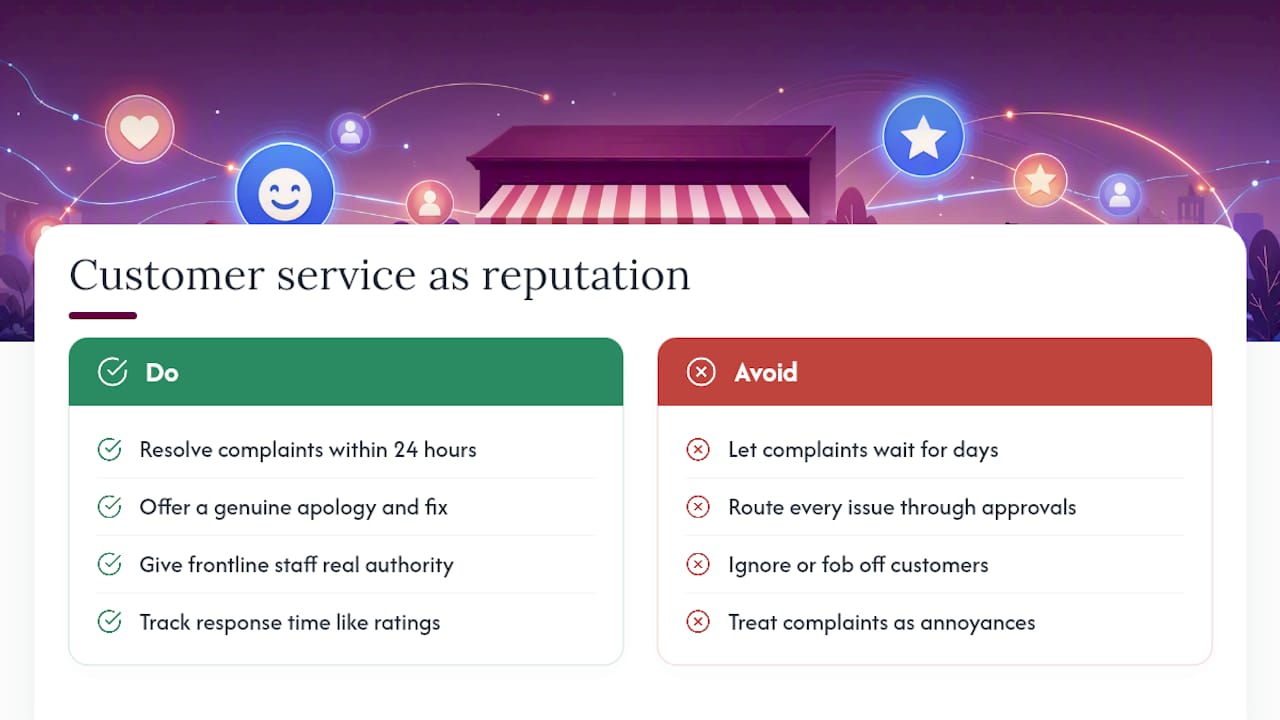
Fast, empathetic resolution at the point of contact prevents most complaints from ever reaching a review site. A customer who gets a genuine apology and a fair fix within 24 hours rarely bothers writing a review at all, good or bad. It’s the customer who feels ignored or fobbed off who goes public.
Train frontline staff to treat every complaint as a potential public moment, not an annoyance to be managed away quickly. Give them real authority to resolve small issues on the spot, whether that’s a refund, a replacement, or a genuine apology, rather than forcing every complaint through multiple approval layers. Delay is what turns a fixable problem into a scathing review.
Track your response time as seriously as your star rating. A business that replies to complaints within hours consistently builds a different reputation to one that takes days, even if both eventually resolve the issue the same way. Speed itself signals respect for the customer’s time, and customers notice.
Treat every resolved complaint as a small case study internally: what went wrong, what fixed it, and whether the same issue could recur elsewhere in the business. This turns customer service from a cost centre into genuine reputation infrastructure.
Can local SEO strengthen your reputation, and how?
Local search visibility and reputation reinforce each other directly. Google’s local ranking algorithm factors in review volume, review recency, and star rating alongside traditional relevance signals, so reputation work is also, functionally, SEO work.
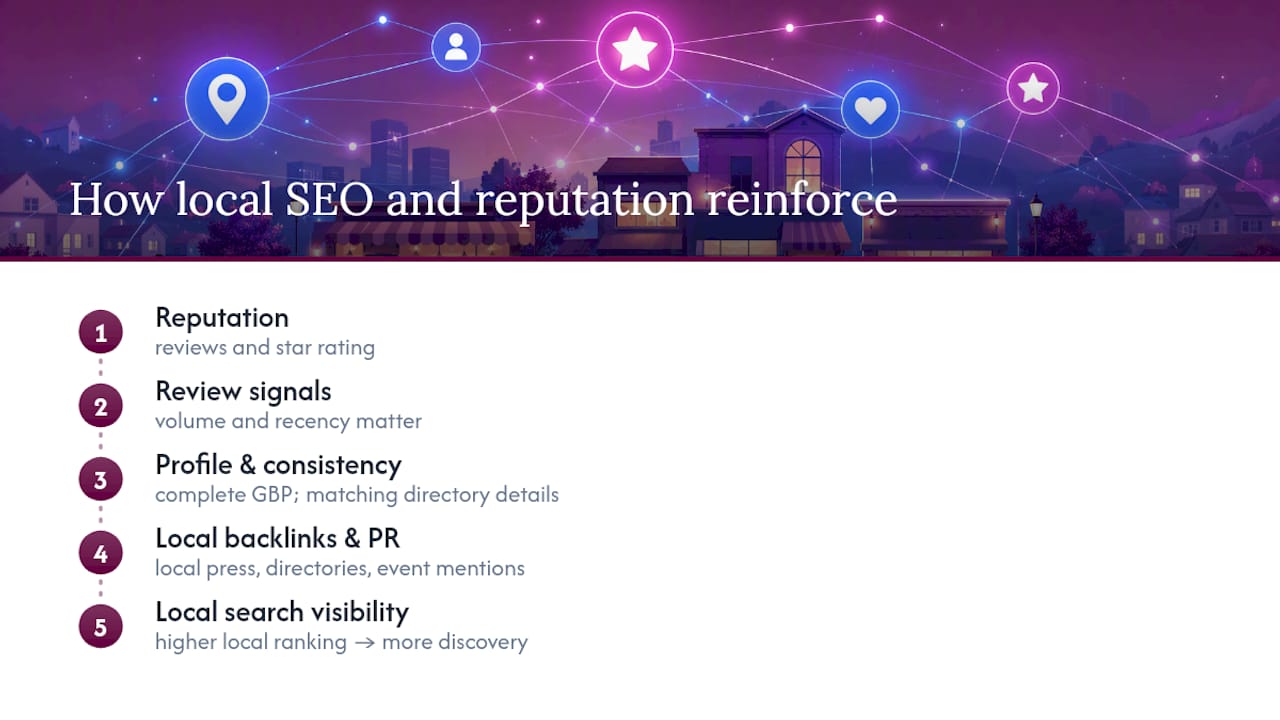
Keep your Google Business Profile complete and current: accurate opening hours, real photos updated seasonally, and a business description that matches how customers actually search for you. Consistency across every directory listing matters too. Mismatched addresses or phone numbers between your website, Google Business Profile, and other directories quietly undermine your local ranking.
Encourage reviews that naturally mention your location and specific services, since this language helps you surface for relevant local searches beyond just your brand name. A reply that references the customer’s specific service or location reinforces this further, giving search engines more contextual text tied to your listing.
Local backlinks help too. Coverage from a local newspaper, a mention on a community events page, or a listing in a trade association directory all strengthen local authority in ways that pure review volume cannot. This is where proactive PR and local SEO overlap directly: the same outreach that earns you a mention in local press also earns you a link that helps your local search ranking.
How do you use social proof in your marketing effectively?
Reviews and testimonials only work as marketing if you actually put them where prospects can see them, rather than leaving them buried on a third-party platform.
Pull specific, credible quotes onto your website homepage and service pages, always with the reviewer’s first name and enough context to feel real. Vague five-star badges convince nobody. A specific line about what the customer needed and how you delivered it works far better than a generic “great service, would recommend.”
Use review counts and average ratings prominently near booking or purchase points, where hesitation is highest. Seeing “4.8 stars from 210 reviews” right next to a call-to-action button reduces the friction of a first-time buyer’s doubt more effectively than the same statistic buried in a footer.
Video testimonials, where feasible, carry more weight than written ones because they’re harder to fake convincingly. Even a short, unpolished clip of a genuine customer talking about their experience often outperforms a slickly produced but generic promotional video.
Refresh your featured testimonials regularly. Static social proof that hasn’t changed in two years quietly signals stagnation, even if the underlying reviews are still accumulating elsewhere.
What does a working reputation checklist actually look like?
Most SMEs overcomplicate reputation management before they’ve mastered the basics. The checklist that actually moves the needle is shorter than owners expect: claim your listings, set alerts, reply to everything within 48 hours, and ask for reviews at the moment of genuine satisfaction, not weeks later.
What surprises most business owners is how much this is a leadership function, not a marketing task. Reputation management works best when it has organisation-wide buy-in rather than sitting solely with whoever manages social media, because the businesses that treat it as strategic infrastructure consistently outperform those treating it as reactive damage control.
The gap between businesses that do this well and those that don’t is rarely about tools or budget. It’s about whether someone owns the process consistently, week after week, rather than in bursts after something goes wrong. That consistency, more than any single tactic, is what separates a resilient reputation from a fragile one.
— Anthony
How can Antios support your reputation management?
Reading this checklist is one thing. Running it consistently alongside everything else a small business demands is another matter entirely, and that’s where a dedicated PR partner earns its keep. A dedicated PR partner can support SMEs needing professional reputation oversight without hiring an in-house comms team, combining ongoing monitoring, response management, and crisis support into one manageable service rather than a patchwork of tools you have to run yourself.

Whether you need a project-based push (a review recovery campaign, a crisis response plan) or ongoing retainer support to keep monitoring and responses consistent week after week, it’s worth matching the scope to your actual risk level rather than defaulting to the biggest package available. Businesses with steady review flow and low complaint volume often do well on a lighter retainer, while those in higher-scrutiny sectors benefit from full crisis readiness built in from day one. Visit the reputation and profile management service page to see how Antiosmulticoncepts structures this work, and get in touch for a scoped conversation about what your business actually needs.
Sources
Harvard Business Review’s study on review responses quantifies the ratings benefit of replying. Xero’s reputation management guide sets realistic timelines for small businesses. Wharton’s online insights piece offers a practical starter checklist, and Gartner’s reputation management article makes the case for treating it as a leadership function.
- Study: Replying to customer reviews results in better ratings | Harvard Business Review
- Online reputation management guide for small businesses | Xero
- Reputation management starts now: build trust before it’s tested | Gartner